Work Is Not a Meritocracy. It Is an Ecology.
The most naïve thing I ever believed about work was that it was based on meritocracy.
Not entirely, of course. I was never so innocent that I thought effort always won, or talent always rose, or goodness was reliably rewarded. Somewhere beneath my strategic mind, beneath my education, beneath every hard lesson I thought I had already learned, there was still a small obedient part of me that believed in the bargain.
Do good work. Tell the truth. Become excellent. Make yourself useful. Let the work speak.
Eventually, I thought, the system would notice.
This was my first misunderstanding.
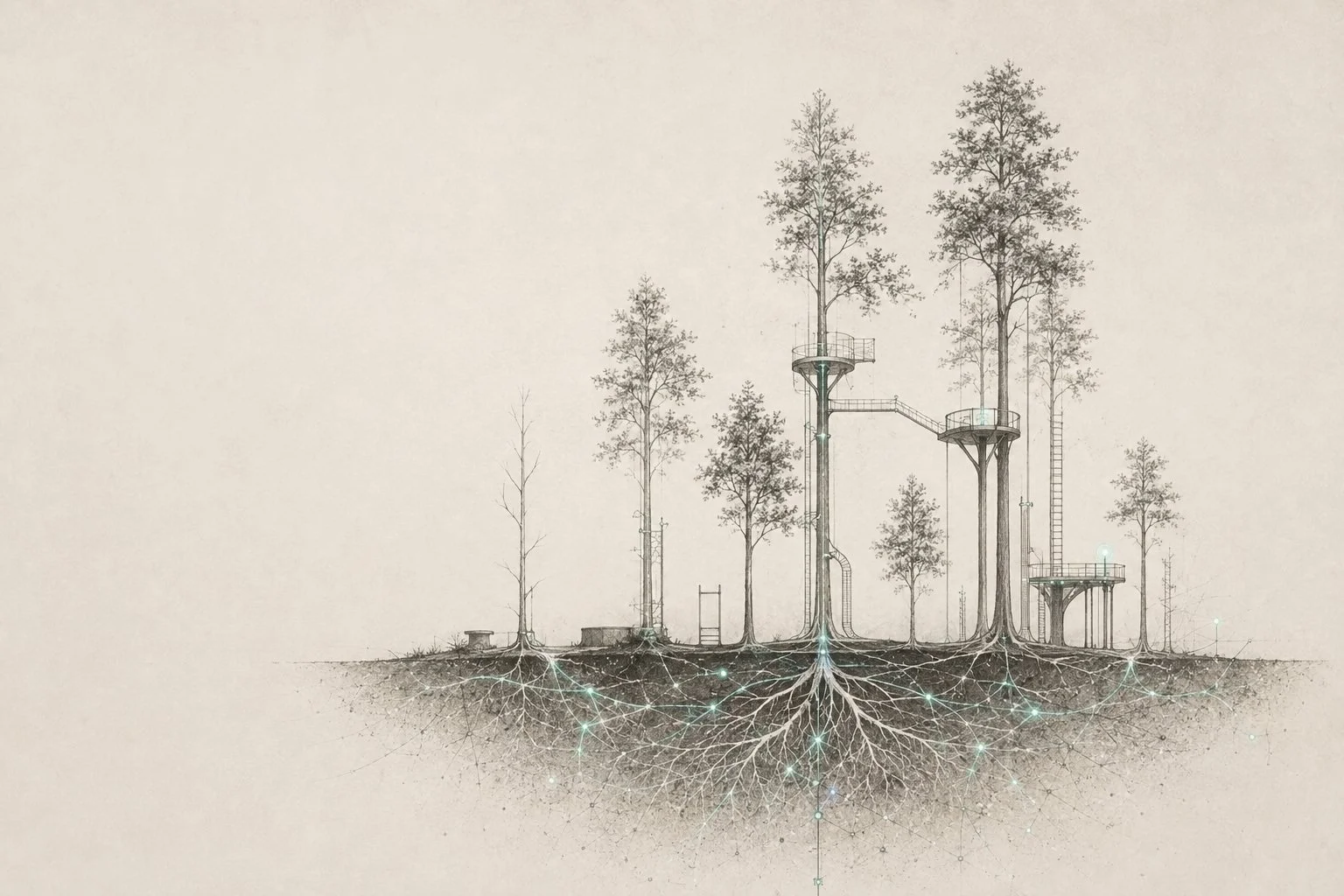
Work does not simply notice. Work is not an eye. It is an ecology.
Our work has weather. It has predators. It has inherited soil. It has invasive species, protected groves, invisible root systems, and organisms that survive not because they are strongest, but because the conditions have been arranged around their survival.
Merit exists, but merit does not exist alone. It needs access, interpretation, sponsorship, safety, contacts, timing, mentorship, and sometimes charisma. Sometimes, dare I say, it even needs neurotypicality.
It needs someone in power to recognize it as merit in the first place. It needs a room capable of seeing the form in which it arrives.
That is where the myth begins to fail.
Not because excellence is false.
Because excellence is never contextless.
Why Meritocracy at Work Is Not Neutral
Many people reach for meritocracy because they are trying to protect something real.
Effort matters. Discipline matters. Excellence matters. Standards matter. There is dignity in becoming skillful, in practicing long enough for the work to deepen, in showing up when no one is applauding.
I do not want a future of work that dismisses rigor, treats competence as incidental, or confuses compassion with the absence of expectation.
Merit becomes distorted when we pretend it can be measured outside of context.
The question is not whether excellence exists. It does.
The question is whether our systems are mature enough to recognize excellence when it arrives in unfamiliar forms.
Who gets prepared before the test begins?
Who learns the language of the room before entering it?
Who is mentored, sponsored, interpreted generously, and allowed to fail without being permanently marked by the failure?
Who is called “promising” because their confidence is familiar?
Who is invited into rooms not because they are most qualified, but because they are easiest for power to recognize?
Who is called “difficult” because their intelligence arrives through pattern recognition, caution, emotional precision, cultural translation, ideas for a new world, or refusal to perform ease?
This is where the myth of meritocracy narrows the human field.
Not because merit is false, but because merit is never alone. It is always growing somewhere. It has soil, weather, history, epigenetics, light.
A more honest meritocracy would not fear these questions. It would welcome them.
Real excellence does not become weaker when we study the conditions that helped produce it. It becomes more accountable, more transferable, and more humane.
The Protective Story of Meritocracy
The defense of meritocracy is rarely just intellectual. It is often emotional.
For many people, meritocracy is the story that made their sacrifices coherent. They worked hard. They endured pressure. They made disciplined choices. They overcame something real.
So when someone questions the neutrality of the system, it can sound like an accusation against their life. It can sound as if their effort is being erased, their sacrifice minimized, their competence reduced to luck.
That is not the point.
A person can truly earn something inside an uneven system.
Both things can be true.
The work can be real, and the field can still be uneven.
The climb can be difficult, and there can still be roads, maps, introductions, safety nets, cultural fluency, inherited permission, and invisible forms of protection that made the climb more possible for some than for others.
This is the maturity our public language often lacks.
We keep asking people to choose between two incomplete stories.
Either success is earned entirely by the individual, or success is merely the product of advantage.
Human life is more complex than that. Most achievement is braided. Most success contains effort and circumstance, talent and timing, discipline and sponsorship, personal courage and social permission.
The future of work will require a language honest enough to hold that braid without humiliating anyone inside it.
The False Binary of Talent
The myth of meritocracy depends on a binary.
Qualified or unqualified. Deserving or undeserving. Excellent or mediocre. Objective or biased. Merit or inclusion. Genius or not a genius.
Work has never been that binary.
A résumé is not a person. A credential is not wisdom. Confidence is not competence. Competence is not always depth. Speed is not always intelligence. Visibility is not always value.
Leadership presence is often cultural familiarity wearing a blazer.
The person who is most well-spoken in the meeting may not be the person who understands the system. The person who interviews beautifully may not be the person who can repair the rupture. The person who looks like leadership may only look like the leaders we are used to compensating for in our families.
That is the danger of inherited imagination.
It keeps mistaking recognition for truth.
The Future of Work Beyond Binaries
I think often about the future version of the world that will look back on us with sadness and precision. Not because we failed to value excellence, because we confused excellence with extraction. First and last, with our families. That’s how you know the foundations upon which we’ve understood work are shifting sands.
We mistook overwork for commitment, polish for wisdom, dominance for leadership. We mistook proximity to power for proof of talent. We mistook the ability to survive a system for evidence that the system was fair.
We also failed to see all the truth we silenced, and all the people who still carry that truth in our society today.
The future will see this clearly, because the future of work will not be organized around the old binaries. Man or woman. Merit or inclusion. Winner or loser. Professional or personal. Objective or emotional. Hard skills or soft skills. Work or life. Growth or care. Profit or ethics.
The old economy loves binaries because binaries make sorting easier.
Sorting is the first language of hierarchy.
Yet many of us understand, inside our own bodies, that binaries fail. The world can be very confident and very wrong at the same time. A form can ask a question the soul refuses to answer. A room can misread you and still expect gratitude for letting you enter.
Survival often requires fluency in systems that were not built to imagine you.
Anyone who has had to study power in order to survive understands organizations more deeply than those who were allowed to confuse comfort with neutrality.
This is one of the great hidden losses of the so-called meritocracy: it has wasted astonishing intelligence by failing to recognize the forms intelligence takes under pressure.
It overlooked the pattern readers. The code switchers, quiet strategists, and relational architects.
The ones who could feel a culture curdling before the metrics caught up.
The ones who knew which policies were symbolic and which ones actually changed the weather.
The ones who spent their whole lives translating themselves across rooms and therefore understood the architecture of rooms.
The ones who had tasted and seen, and therefore could not untaste or unsee.
The signal beneath the static.
The ones the old system called too much, too sensitive, too complex, too political, too difficult, too strange.
There have always been names for this archetype within our species.
The seers, scouts, interpreters, threshold keepers, wounded strategists, awkward truthtellers, and culture readers.
The ones who knew where the room was lying before the room knew it was lying.
Meritocracy calls them naïve.
The future will call them collaborators.
Real Merit Can Survive Questions
I do not reject merit. This is important.
I reject the childish version of merit.
The version that imagines talent can be separated from context. That performance can be separated from permission. That achievement can be separated from history. That work can be separated from the body doing it.
Real merit is not fragile.
It does not need to banish complexity in order to feel legitimate.
Real merit can survive questions.
Who had room to develop?
Who was interrupted before they became visible?
Who was punished for traits later praised in someone else?
Who was quietly uninvited after speaking up?
Who was allowed to fail safely?
Who had to be twice as prepared to be considered half as promising?
Who was called “a natural fit” because the room had been built around their shape?
A mature meritocracy would want these questions.
A false one fears them.
This is where the conversation must become more honest, because the goal is not to replace one form of unfairness with another.
The goal is not to flatten excellence. The goal is not to pretend that effort is meaningless, talent is irrelevant, or standards are oppressive.
The goal is to build systems capable of seeing more truth.
Work Is an Ecology, Not a Meritocracy
This is why I no longer believe work is based on meritocracy.
I believe work is based on ecology.
In an ecology, outcomes are never the product of one variable. Impact emerges from relationship: soil, climate, competition, cooperation, disturbance, adaptation, inheritance, and care.
A tree does not grow tall because it is morally superior to the seedling beneath it.
It may have found better light. It may have been planted earlier. It may have deeper roots, drawing from a fungal network no one can see.
It may also shade what grows below and mistake the shadow for proof of its greatness.
That does not make the forest sentimental. It makes the forest honest.
Every part of a forest is part of its honesty.
The canopy. The understory. The root system. The decay. The light. The competition. The symbiosis. The weather. The damage. The repair.
That honesty matters because if we misunderstand why one tree flourished and another did not, we will keep designing forests that confuse domination with health.
We will keep rewarding the canopy while starving the understory.
We will keep calling the absence of growth a failure of will, instead of asking what happened to the soil.
This is the future of work I want to help build.
Not a sentimental workplace.
Not a careless workplace.
Not a workplace where standards disappear.
A more exacting and truthful one.
A workplace where excellence is not separated from context.
Where care is not treated as decoration, rigor does not require cruelty, fairness does not mean sameness, and identity is not treated as the opposite of competence.
Where leadership is measured not only by who rises, but by what becomes possible around them.
The Future Belongs to the Whole Forest
The future does not belong to those who cling to meritocracy as a myth of innocence.
Neither does it belong to those who abandon excellence.
The future belongs to those who can hold excellence and repair in the same hand.
Those who understand that fairness is not sameness. That rigor is not cruelty. That inclusion is not charity. That identity is not the opposite of competence. That care is not the enemy of performance. That context does not erase effort.
A wiser world does not humiliate effort.
It tells the truth about where effort was allowed to grow.
The future of work will not be built by people defending the canopy as if sunlight has been equally distributed.
It will be built by those brave enough to study the whole forest.
We know this.
We have always known this.
Not because institutions told us the truth, but because many of us became fluent in the truths institutions could not easily categorize, ourselves included.
We learned to read weather, study rooms, and feel when the language of fairness was being used to protect an unfair design.
The binary was never truth.
It was a fence.
Fences always tell you more about the fears of the builder than the nature of the land.