The Soil Beneath Our Markets
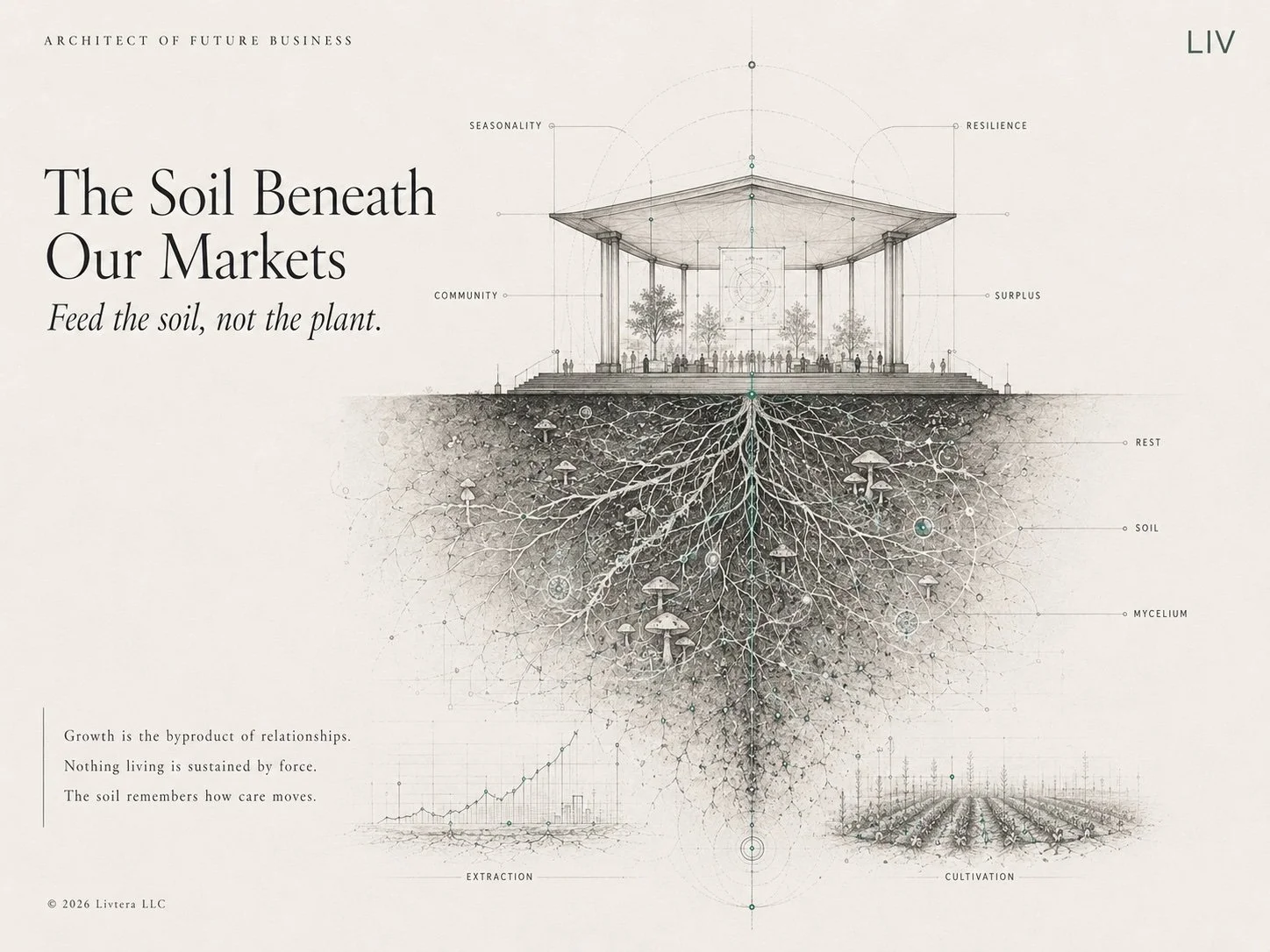
There are two ways to grow food.
One way begins with disturbance. The earth is split open. What is there is turned under. What competes is killed. What is lacking is supplemented. Yield is measured, forecasted, insured. The field is disciplined into obedience.
We plow forward, looking for graphs that move the way investors like graphs to move: exponentially, predictably, up and to the right.
It is linear. It is profitable. It is managed.
The other way begins with observation. The soil is not turned but covered. Weeds are not enemies but indicators. Microorganisms are fed. Inputs are indigenous. The farmer watches longer than they act. Yield is invited through relationship.
These are not simply techniques. They are philosophies of life.
Every economic system is a farming practice applied to human beings.
The Industrial Inheritance
The twentieth century industrialized war, and in doing so, created a production funnel. When World War II ended, that machinery did not vanish. It redirected itself.
Nitrogen plants once used for explosives expanded into fertilizer production. Organophosphate research found agricultural application. Factories built for tanks and artillery turned toward tractors and combines.
The tools changed.
The underlying logic did not. Scale. Control. Output.
Eliminate uncertainty.
It was not only an economic system. It was a worldview. It was an understandable inheritance, but it shaped how we farmed. And how we built companies.
We assumed that more input meant more life. More capital, leverage, incentives, speed, followers.
If something failed to grow fast enough, we stimulated it. If something competed, we eliminated it. If something resisted standardization, we called it inefficient.
The Glow of Synthetic Growth
In conventional agriculture, synthetic nitrogen can produce impressive green growth. The fields glow. The yields rise. But the soil grows dependent. Microbial life diminishes. Structure weakens.
The land becomes an addict, requiring more input for the same result. Our markets have followed the same pattern. Debt stimulates growth. Hype inflates valuation. Productivity tools promise optimization. Quarterly returns become the season that never ends. Companies glow bright for a decade, then collapse inward, hollowed out by the very speed that once made them shine.
We call this innovation, development, a company’s life cycle.
The Nervous System of Extraction
When a person does not trust their own resilience, they overcompensate.
They control. They overwork. They push past fatigue. They seek validation through output. They eliminate anything that threatens momentum: rest, reflection, competing desires, unmeasured relationships, grief, play, the body’s slower intelligence. Eventually, the body revolts.
The soil of a nervous system can only be tilled so many times before it loses structure. The topsoil lifts. The dust storm moves inside us, and sometimes, eventually, an entire civilization enters a great depression.
Extraction is not only an economic strategy, it is a psychological posture. It is what happens when we do not trust that life, if properly tended, knows how to regenerate.
Natural Farming as a Different Philosophy of Business
Natural farming proposes something quieter and far more radical.
Do less. Interfere less. Trust more. Feed the soil, not the plant.
In this approach, the goal is not domination but participation. The farmer works with microorganisms, fungi, insects, cover crops, weather, decay, and time. Growth is the byproduct of relationships.
Weeds are data. Pests are feedback. Decay is not waste but nutrient.
The work is slower. The yields may not spike dramatically. But over time, the soil deepens. It becomes resilient. It holds water during drought. It withstands stress. It produces not only crops, but continuity.
What would it mean to build business this way?
To feed the ecosystem instead of extracting from it?
To design companies that strengthen the communities they draw from rather than hollowing them out?
To see employees not as units of productivity, but as living systems that require rest, diversity, depth, and microbial richness?
Perpetual Summer
The dominant story of capitalism has been acceleration.
Scale quickly. Capture market share. Outcompete. Exit. Growth is the moral good. Stagnation is failure. But in natural systems, growth is seasonal. There are times for expansion and times for root-building. There are fallow years. There are cycles of visible abundance and invisible preparation.
The forest does not apologize for winter. Our markets, by contrast, attempt perpetual summer. The result is burnout. Not only individual burnout, but ecological and institutional burnout. Supply chains stretched to fragility. Workers exhausted. Land depleted. Attention fragmented. Loneliness rising in hyper-optimized environments that have engineered out friction, and with it, belonging.
We have confused velocity with vitality.
Monoculture Looks Efficient Until It Fails
Natural farming suggests that vitality cannot be forced. It emerges from conditions.
Healthy soil teems with unseen collaboration. Fungi connect roots across distance. Nutrients cycle through decay. Nothing is wasted. Nothing is rushed.
Conventional systems, by contrast, isolate and sterilize. Monocrops replace diversity. Uniformity replaces complexity. Control replaces connection. And here is the uncomfortable question: Which model more closely resembles our work?
We celebrate monoculture. Single platforms dominating entire sectors. Universal metrics. Standardized KPIs.
Growth benchmarks applied across different organisms as if every company, community, and person were the same crop in the same field. We sterilize risk through compliance and litigation. We lobby to eliminate competitors instead of learning from them. We optimize until the system becomes too brittle to survive surprise.
Monocultures look efficient until they fail. Then they fail catastrophically. A forest with biodiversity bends under stress. A field of identical plants falls all at once.
Profit Is Surplus Energy, Not Liquidation
The future of business will not be decided by artificial intelligence, blockchain, or whatever new fertilizer we invent next. It will be decided by whether we continue to treat our economies as machines to be optimized or as ecologies to be tended.
This is not a sentimental argument against profit. Profit is a relationship. We simply do not see it that way yet.
In a natural system, profit is surplus energy. It is the excess that allows reproduction, repair, resilience, and generosity. But surplus extracted at the expense of the system’s long-term health is not profit. It is liquidation.
Self-sabotage in an individual looks like pushing beyond limits, ignoring warning signs, numbing discomfort, and chasing validation through performance. Self-sabotage in a civilization looks like depleting soil, burning labor, scaling without roots, and calling extraction innovation. We stand at a psychological crossroads more than an economic one.
Darwin helped us understand survival of the fittest. Now we have to understand survival of the wisest.
Do we believe life must be forced into productivity?
Or do we believe that life, when properly nourished, tends toward generativity?
What Humility Would Look Like in Business
Natural farming requires restraint.
It demands that the farmer resist the urge to intervene at every imperfection. It requires patience in a culture addicted to immediacy. It asks for humility, an acknowledgment that intelligence exists in the soil, in the microorganisms, in the relationships between species, not only in the planner standing above the field.
What would humility look like in business?
It might look like slower growth. Smaller margins. Fewer expansions. More listening.
It might look like leaders who understand seasonality, who allow contraction without panic, who build reserves during abundance, who value depth over domination.
It might look like companies that measure success not only in revenue, but in regenerative capacity.
Are employees healthier after working here?
Is the community stronger?
Is the land more alive?
Are relationships more trustworthy?
Is the system more capable of surviving stress?
These questions sound idealistic only because we have normalized depletion.
The kinetic reality is simple: Systems that extract without replenishing collapse.
This is true of soil.It is true of bodies. It is true of markets.
Feeding the Soil Beneath the Markets
We can continue to till deeper, add more synthetic stimulus, chase more yield, and marvel at the short-term glow. We can keep glorifying competition as if it is the best expression of our species. Or we can begin feeding the soil.
The choice is not between capitalism and something else. The choice is between a nervous system built on anxiety and one built on trust. And yes, companies have nervous systems.
One model dominates life to secure growth. The other participates in life and receives growth as a consequence.
If the future of business has any hope of continuity, it will look less like conquest and more like cultivation. It will require that we relearn how to kneel — not in submission, but in attention.
Because the soil beneath our markets is alive. And it is responding to how we farm it.