The Zoo We Built for Kindness
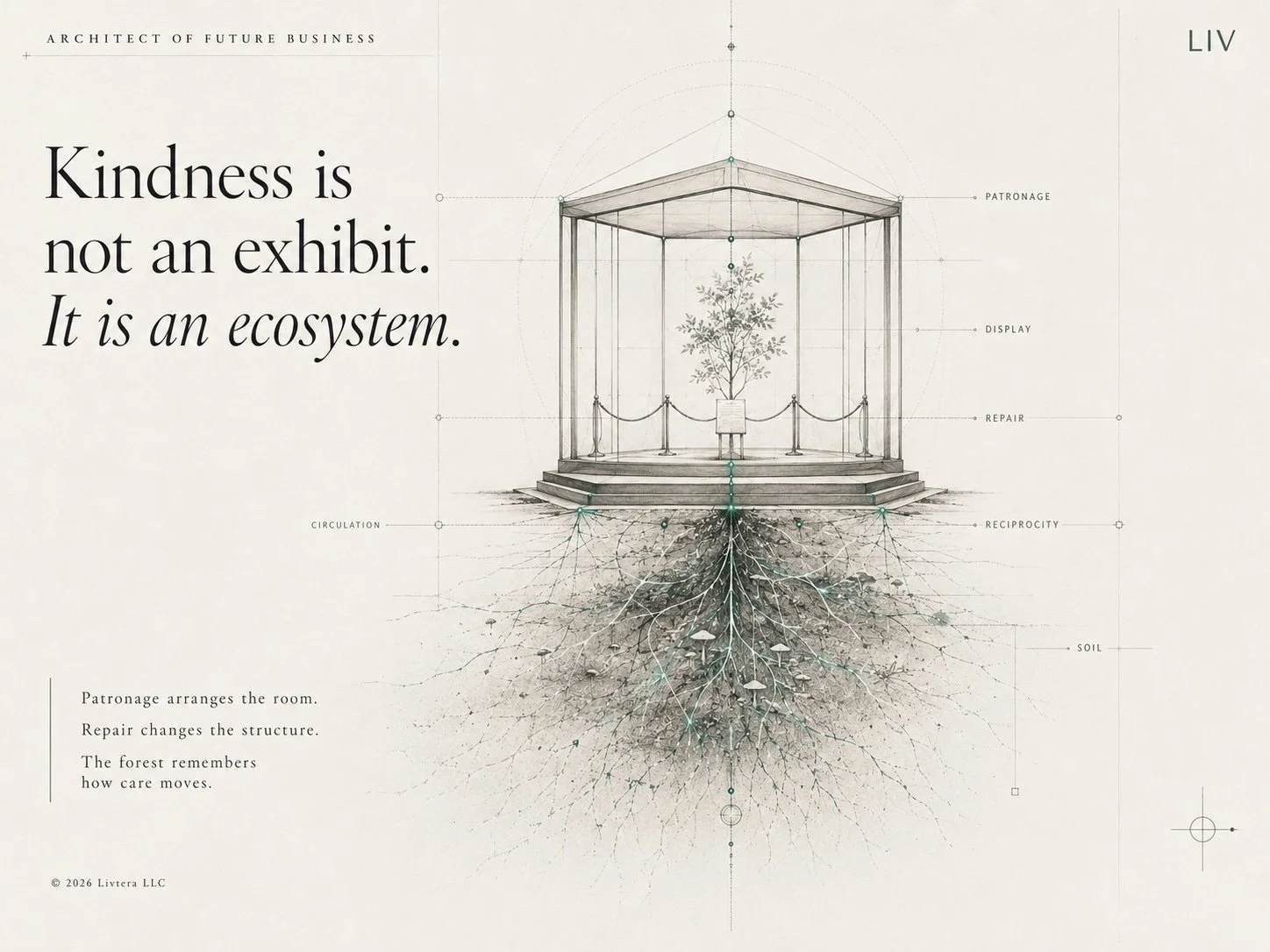
There is a moment, usually early in adulthood, when someone hands you a badge. Not a real badge. A psychological one.
It reads:
Welcome to the workforce.
Your current power status level is less than theirs.
Whoever they are. There are many different theys.
No one says this directly. You learn it through small atmospheric changes. In conference rooms. In email length. In who is allowed to be brief and who must be warm. In who is believed immediately and who must arrive carrying evidence. In whose delay is treated as discernment and whose delay is treated as disorganization.
Eventually you learn that some people have a special title in your work destiny. Strategic relationships.
When Care Has to Learn the Language of Capital
I understood this most clearly when I became an entrepreneur in the nonprofit world. The organization’s mission was healing, access, and community care, but the work required another skill entirely.
Design events wealthy people would want to attend.
Create spaces where generosity felt beautiful.
Learn their stories, their preferences, their emotional weather.
Remember who liked which wine, who preferred not to be photographed, who needed privacy, who needed recognition, who wanted data, who wanted tears, who wanted to feel useful without feeling implicated.
Cultivate the relationship carefully so resources could move from them into the work.
Make it authentic.
Make it optimized.
Make it feel human without ever forgetting the spreadsheet underneath.
In other words, translate compassion into a language capital recognizes, and it works. That is the difficult part.
Programs appear that would not exist otherwise. Anonymous donations materialize. Therapists get paid. Clients receive care. A clinic survives another year. Sometimes an entire organization rises from the ground because someone in a well-tailored jacket decided the cause mattered.
So the problem is not simple.
It would be easier if the wealthy were only villains.
It would be easier if nonprofit leaders were only compromised.
It would be easier if donors only wanted power and founders only wanted purity.
However, most people are more complicated than that.
Many donors are kind. Many are sincere. Many have carried private grief into public generosity. Many are trying, in the language available to them, to participate in repair. Some give because they have more than they need. Some give because they know they have benefited from systems that did not benefit everyone. Some give because they want their lives to mean something beyond accumulation.
Still, after a while, you begin to notice the choreography.
The Quiet Choreography of Donor Power
One evening at a fundraising dinner, I watched an entire room rearrange itself around the late arrival of a donor.
Staff paused with drinks hovering mid-sip.
A few people straightened their jackets.
Someone adjusted the placement of a chair.
The guest of honor was a man whose wealth had been mentioned to me several times that week, always with a soft reverence, as if his net worth had entered the room before he did.
When he arrived, the room warmed toward him.
People leaned forward when he spoke.
Laughter arrived half a second sooner.
He was kind.
Thoughtful, even.
He asked good questions about the work.
Yet, what stayed with me was the choreography.
How easily the room bent.
How quickly intelligence reorganized itself around proximity to wealth.
How carefully the space had been curated for the possibility that he might come, and how effortlessly it perfected itself upon his arrival.
Somewhere beneath the linen napkins and polished glassware, I felt a small betrayal take place.
Not because he had done anything wrong.
Not because the staff had done anything wrong.
Not because the mission had stopped being worthy. In some quiet structural way, the dignity of the work had been placed on the table beside the bread plates, waiting to see if he approved.
The work arranged like an exhibit.
He, the patron.
And me?
Not only the founder.
The curator.
The translator.
The keeper of the enclosure.
How Nonprofit Fundraising Turns Care Into an Exhibit
This is the part that is harder to confess.
At first, I thought I was only witnessing the zoo.
Later, I understood I had helped build it.
Not because I wanted a cage.
Because I wanted the animals fed.
Because I wanted the doors open.
Because I wanted the work to live.
Because the grant cycle demanded a story.
Because the donor packet needed a narrative arc.
Because suffering had to become legible before it could become funded.
Because care, on its own, was not enough. It needed lighting. It needed metrics. It needed testimonials. It needed a table host. It needed a follow-up email with the right amount of gratitude.
Spend long enough inside that arrangement and you begin to notice the enclosures the pitches live within.
Visitors, investors, funders, and donors stroll past with drinks in their hands, deciding which exhibits to support this season.
Some pause longer than others.
Some ask beautiful questions.
Some reach through the bars and feed the animals.
Many are generous.
Still, the architecture is difficult to ignore.
Certain causes draw larger crowds.
Certain organizations become the most captivating exhibits of the evening.
Certain wounds photograph better.
Certain communities become fundable when the political weather changes.
Certain forms of suffering are moving enough to open wallets but not disruptive enough to threaten the conditions that created them, and eventually a quiet question appears.
Why does goodness have to perform before it is allowed to exist?
Why must care become a spectacle before it becomes resourced?
Why must dignity learn choreography?
The Difference Between Generosity and Repair
This is not only a critique of philanthropy.
It is a critique of the spiritual arrangement beneath it.
A society accumulates wealth in one place, need in another, and then asks the place of need to make itself emotionally compelling enough for wealth to return as generosity.
Then everyone claps. Sometimes they should, because the gift matters.
The clinic matters.
The meal matters.
The therapy session matters.
The scholarship matters.
The rent paid on time matters.
Yet, we also know that the applause can hide the architecture.
It can hide the fact that many forms of kindness are downstream from arrangements that required unkindness somewhere else.
It can hide the way we have confused generosity with repair.
Generosity gives from what remains.
Repair asks why it was taken.
Generosity may be beautiful.
Repair is accountable.
Generosity can preserve the distance between giver and receiver.
Repair has to cross it.
Why the Performance of Goodness Becomes Exhausting
For a long time, I thought seeing the enclosure was the point. However, recognition is only the first step.
Once you see the choreography clearly enough, you begin to lose the ability to perform it the same way.
The bow feels heavier.
The laughter feels a fraction too early.
The praise feels over-rehearsed.
You start to notice how much energy the room spends maintaining the illusion that generosity must descend from above.
You start to feel the exhaustion of staging goodness for people who may already believe in it, but have been taught to enter through the patron door.
Slowly, almost quietly, your imagination begins to wander somewhere else.
Toward smaller rooms.
Toward circles instead of stages.
Toward tables where no one is seated according to giving capacity.
Toward forms of help that move sideways rather than downward.
Toward a world where care does not have to become an exhibit to be believed.
Beyond Patronage: Remembering the Forest
I do not think the future of kindness will arrive by perfecting the zoo.
The pitches have never been the whole problem.
Neither, it turns out, were the visitors.
Most donors I have known were not looking for a cage to stand outside of. They were looking for a way into a healthy ecosystem. A way to participate in something that mattered. A way to feel their life move toward usefulness instead of accumulation alone.
Many rich people are good people, but goodness trapped inside the architecture of patronage still behaves like patronage.
That is the grief.
Not that people are evil.
That the roles are too small for the humanity inside them.
The donor becomes the rainmaker.
The founder becomes the supplicant.
The staff become proof.
The clients become story.
The mission becomes a display.
Everyone, even the generous, loses some part of their dignity to the performance.
What changes the story is something much simpler.
We remember the forest is still here.
The Soil Does Not Care Who Donated the Rain
The forest does not organize itself around patrons.
The soil does not care who donated the rain.
It receives what arrives.
It grows what it can.
It keeps its dignity.
Nothing in the forest survives alone, but not everything has to perform its need in order to be fed. Roots exchange information in darkness. Fungi carry messages beneath the visible world. Fallen leaves become nourishment without issuing a press release. Water moves because it is water. Seeds travel because the wind remembers what institutions forget.
Life knows how to circulate.
When people step out of the zoo together — founders, staff, neighbors, investors, donors, clients, volunteers — the roles begin to soften.
No one has to stand outside the cage.
No one has to be displayed inside it.
The work becomes less of a spectacle and more of a living system.
A donor may still bring rain.
A volunteer may still tend soil.
A staff member may still prune what is diseased.
A founder may still watch for weather.
A client may still become a gardener.
However, the point is no longer who gets thanked from the stage.
The point is whether life can keep moving.
Care passing from one pair of hands to another.
Money becoming access.
Access becoming stability.
Stability becoming imagination.
Imagination becoming new structures.
New structures becoming fewer cages.
No speeches.
No spotlight.
No dignity placed beside the bread plates, waiting for approval.
Just the quiet intelligence of people remembering how to grow in healthy soil.