Good Things Do Not Happen to Good People, Part III: Nineteen Years Underground
There are stories from the past nineteen years that I still do not know how to tell. Not because I have forgotten them. Because experience and language do not mature at the same speed.
For almost two decades, the astrological framework I use to understand my life has placed me inside a Saturn Mahadasha. In Vedic astrology, Mahadashas are long planetary periods: eras rather than moments, each associated with a particular symbolic terrain. Saturn's lasts nineteen years.
In my natal chart, Saturn sits in the eighth house. The eighth is not known for light conversation. Death and rebirth. Other people's resources. Power. Inheritance. Secrecy. Loss. Transformation. The hidden machinery beneath what appears stable. The things beneath the floorboards.
I do not need astrology to function as empirical science for the metaphor to have been useful to me. Asked what nineteen years of Saturn in the eighth house felt like, I would offer Dante.
You are going into the Inferno. The important part is this:
Not necessarily because you did something wrong.
Nineteen Years Underground
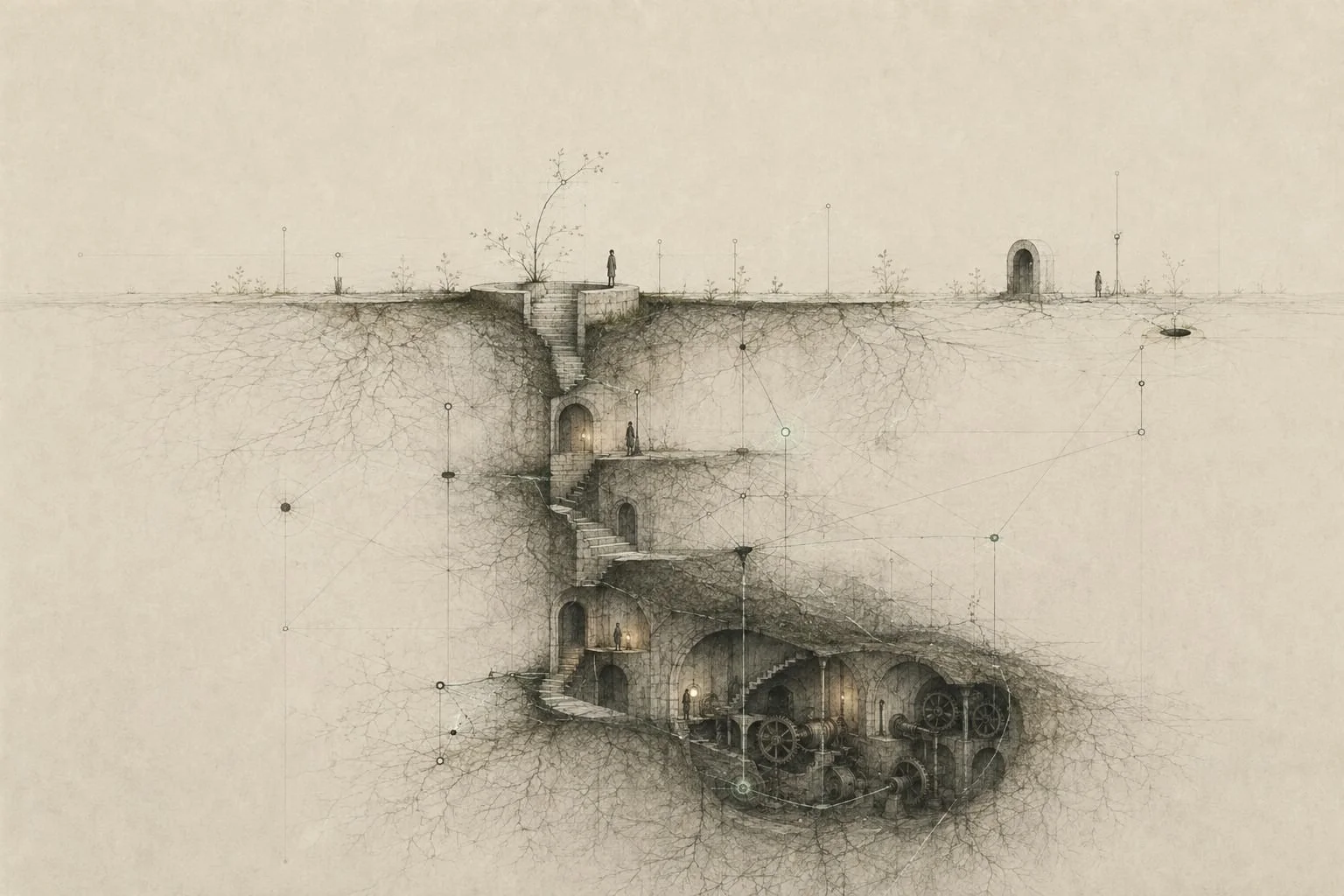
Imagine spending years beneath the visible world.
Roots. Rot. Mycelium. Bone. The long decomposition of whatever cannot come with you.
Meanwhile, life continues above ground. People marry. Your family holds reunions. Careers accelerate. Holidays recur with almost insulting reliability. Other people appear to remain inside ordinary time while your own life becomes excavation.
Nineteen years is long enough to watch structures you believed permanent become material. It is also long enough to discover something our culture is strangely reluctant to teach:
Suffering is not always instruction. And it is certainly not always punishment.
Sometimes the conditions were bad. Someone failed you. A system protected itself. A person knew what they were doing and benefited from it. There may be no later scene in which the truth is publicly established and everyone receives the appropriate moral consequence.
You may eventually succeed anyway.
Then people who contributed to your suffering may say, I always knew you could do it.
Others will call the outcome luck, which is one way of acknowledging what became undeniable without examining what happened on the way there.
For years, I wanted life to become tidier than this.
It did not.
Erasure Has a Particular Temperature
The recurring experience I encountered underground was not always hostility.
It was erasure. Erasure is more sophisticated than open rejection because nothing visible has to occur. There is no announcement. No one says:
We have decided that who you are makes you less legible here. Consider yourself nonexistent.
The organization simply continues. The group photos are framed without you in them. Eventually, the system forgets you were ever there.
A contribution becomes someone else’s idea. A room uses your intelligence without allowing your authority to travel with it. People respect you privately and omit you publicly. Support never quite arrives. The institution praises itself for fairness while recognition continues flowing toward the people it already knows how to see.
Eventually, you start asking whether what is happening is happening at all. That is part of the mechanism. Overt harm gives a person an object to resist. Erasure produces ambiguity. There is rarely a single incident large enough to explain the wound, only hundreds of small absences whose cumulative meaning becomes impossible to ignore.
I have spent years trying to understand the difference between being unseen because of something I did and being unseen because of what another person believed someone like me could be.
Those are different injuries. The first can invite development. The second asks you to disappear in order to become recognizable.
Not Every Wound Is Wisdom
There is a temptation, especially when writing retrospectively, to make suffering too useful. We want the betrayal to have taught discernment, the deprivation to have created discipline, the loneliness to have generated independence. If the story ends well enough, we can convert every wound into curriculum.
I distrust that instinct now.
Some experiences developed me.
Some simply hurt.
Some capacities I possess were sharpened by difficult conditions, but I would never design those conditions for another human being merely because I survived them.
That distinction matters to Work Ecology.
We routinely observe someone who endured a destructive environment, admire the capabilities they built inside it, and then preserve the environment as though the suffering caused the excellence. Sometimes excellence develops despite the condition rather than because of it. Survival is evidence of capacity. It is not automatically evidence that the environment was good. This is one reason I have become less interested in resilience as a cultural ideal. Resilience has value. There are moments when human beings need to endure what cannot immediately be changed.
But resilience becomes morally incongruent when the person causing the wound recommends it to the wounded.
Institutions Have Eyes
Organizations like to imagine recognition as neutral.
The best ideas rise. Good work gets noticed. Competence becomes authority. Talent finds its level.
Anyone who has spent enough time inside institutions knows recognition is far more social than that.
Institutions have eyes. They are trained by history, status, familiarity, power, race, class, gender, credentials, accent, temperament, friendship, aesthetics, pedigree, and whatever image of leadership the people in charge learned before they were old enough to question it. This does not mean every omission is oppression or every unsuccessful person has been misjudged. Human beings are perfectly capable of failing through our own decisions, limitations, arrogance, fear, or lack of skill. But a system cannot understand itself if personal responsibility is the only explanation it permits.
A mature institution must be capable of asking whether the thing it cannot see is actually absent. That question is difficult because systems protect their perception of themselves.
An organization can sincerely believe itself generous while repeatedly producing abandonment. A family can sincerely believe itself loving while erasing a scapegoat. A profession can sincerely believe itself meritocratic while confusing familiarity with competence. Self-image is weak evidence. Patterns are better.
The Next Economy Has to Become Better at Seeing
We spend enormous energy deciding who deserves success. I have become more interested in another question:
What conditions allow human beings to become visible enough to contribute what they actually carry?
That is an economic question. A leadership question. A family question. An architectural question. A survival question.
Organizations stop receiving honest information when people learn what honesty costs. Workers stop believing effort will produce security when the relationship between the two becomes too weak. Citizens stop trusting institutions that cannot accurately perceive the lives occurring inside them.
Markets can continue functioning after trust begins to decay. Institutions can report growth after their roots have begun to starve. That is what makes systemic decline difficult to see in real time. The indicators above ground remain green.
Underground is another matter.
Mercury
My Saturn Mahadasha is ending.
The Mercury Mahadasha follows Saturn in the Vimshottari dasha system and lasts seventeen years.
I have wondered what it means that the period associated, in my own imagination, with descent is followed by one associated with language, exchange, intelligence, writing, translation, and movement.
Maybe I am imposing a story on it. But I like the possibility that one period took me underground and the next might ask me to describe what I found there. Not to prosecute the past. Not to convince the people who failed to see me that they should revise their records. That would still place my life inside their perception.
The more interesting task is to become precise about the machinery.
What makes a person disappear inside a family, company, profession, or country? What causes certain forms of knowledge to become legible only after someone with greater status and less integrity repeats them? Why do some systems require a person to break before believing their account of what the system is doing to them? And what would we build differently if we understood those mechanisms before they became wounds?
Maybe that is what nineteen years underground gave me. Not justice. Sight.
I no longer believe every difficult thing happens because we are supposed to learn from it. I do believe we have a responsibility to become more accurate because we survived it.
Saturn does not need to become the villain of my life. In fact, Saturn has become a lifelong friend.
Saturn marks an era in which much of what I trusted was placed under pressure until I learned to distinguish what was structural from what was mine. What is true and what was false all along. Distinction that have changed everything.
I do not know what the next seventeen years will bring. I know I am entering them with better sight.
Maybe they will be less about surviving the descent than naming its machinery. Less about proving what happened, and more about understanding how it happened. How systems erase. How recognition is distributed. How some people are asked to disappear before they get to understand why.
If the last nineteen years taught me anything, it is that survival is not the final task.
Seeing clearly is.
—
Good Things Do Not Happen to Good People
Part I — Conditions
Part II — The Trophy Has One Name
Part III — Nineteen Years Underground