Good Things Do Not Happen to Good People, Part II: The Trophy Has One Name
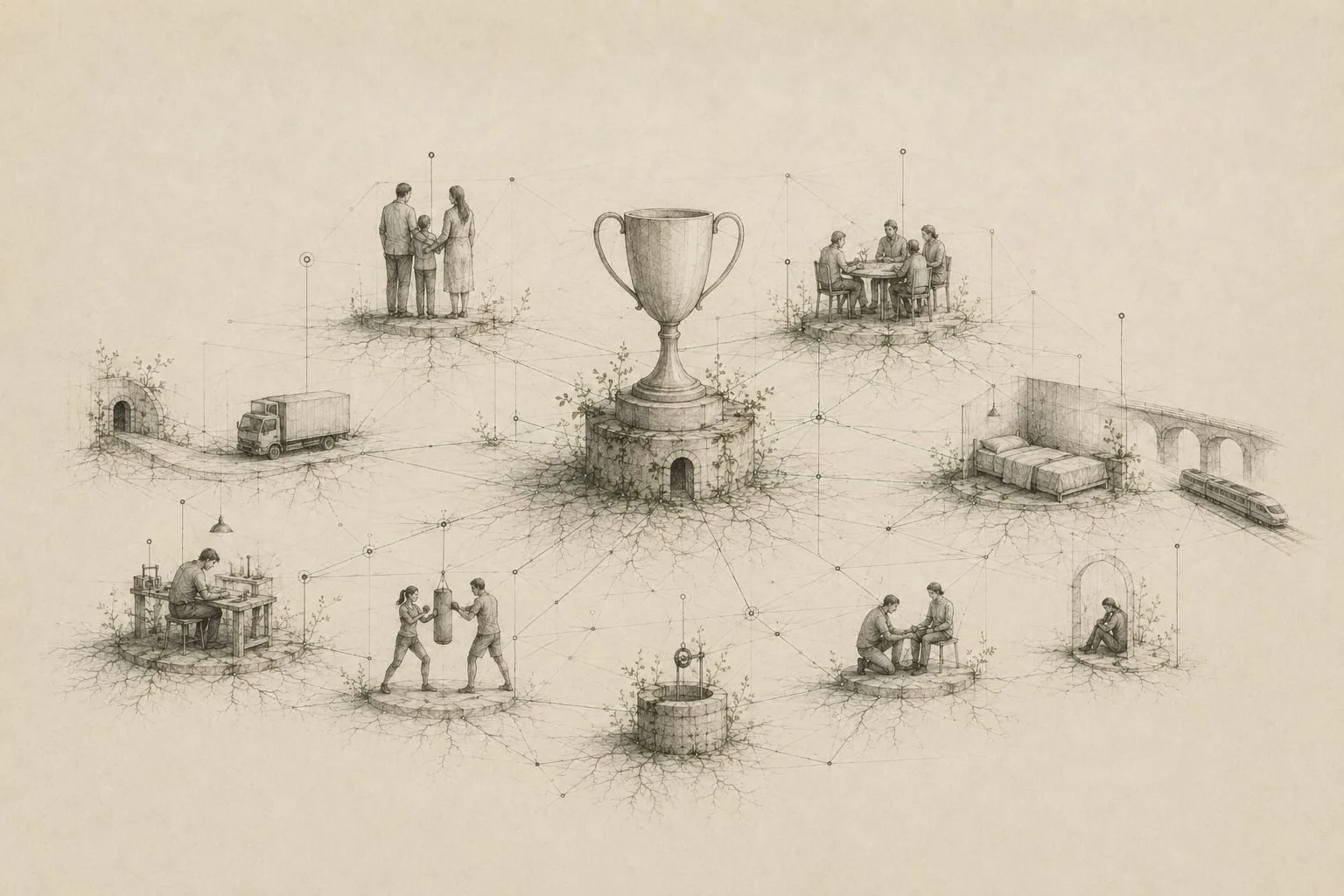
A Formula One driver appears alone inside the car. A tennis player stands alone on their side of the net. Their names are printed on the trophies.
Look closely enough, though, and the individual begins to disappear into an organism.
There are parents, siblings, coaches, money, transportation, medical care, recovery, meals, sacrifice, luck, timing, and years of invisible labor. Someone drives before sunrise. Someone earns enough money to keep the experiment alive. Someone rearranges family life around a talent whose value has not yet been proven.
By the time the world sees excellence, much of the infrastructure that produced it has become invisible.
We mistake the final performer for the whole system.
Excellence Is Often a Family Achievement Wearing One Person’s Name
Max Verstappen grew up inside a racing family. His father, Jos Verstappen, brought professional racing knowledge to his development and invested enormous time into turning childhood ability into elite performance. His sister Victoria raced too.
Max has said that, when they were young, he believed she possessed roughly the same talent he did.
But only one child became a Formula One world champion.
Dutch journalist Jack Plooij has described a family system that eventually concentrated resources and attention around Max’s racing trajectory. He has also reported that once serious wealth arrived, Max arranged for Victoria to receive the same salary from the family company that he did, despite not being expected to perform equivalent work.
That private financial arrangement is reported rather than independently documented, so I do not offer it as proof of anything larger.
What interests me is the recognition embedded in the story.
A trophy may have one name while an achievement has many authors.
We have poor economic language for this. The visible labor becomes talent. The invisible labor becomes love. One receives a market valuation. The other disappears into the biography.
Yet support is not adjacent to performance.
Support is part of performance.
Novak Djokovic offers another version.
His record is usually described through extraordinary discipline, and rightly so: twenty-four major singles titles, a record 428 weeks as world number one, and a professional career spanning generations of competitors.
But discipline becomes misleading when it is treated as a solitary possession.
Djokovic has spoken repeatedly about what his parents and brothers sacrificed while he developed as a player in Serbia during periods of profound economic and political instability. His adult career has since been structured around an elaborate ecology of recovery: sleep, food, physical preparation, mental regulation, spiritual practice, family, medical care, and careful management of his competitive calendar.
His wife, Jelena, has been part of that architecture for more than two decades. Djokovic has described the burden she has carried in family life while his profession repeatedly takes him elsewhere.
None of this diminishes his achievement.
It explains how achievement becomes repeatable.
We Study the Athlete and Ignore the Training Facility
Business culture loves elite performers.
We put athletes on stages and ask about visualization, sleep, resilience, competition, cold plunges, breathing techniques, diets, morning routines, and mental toughness. Then we carry those answers back into organizations as though performance were transferable by ritual.
Wake earlier. Become disciplined. Manage your energy. Think like a champion.
What disappears from the lesson is everything expensive.
The mother driving six hours. The sibling surrendering an opportunity. The spouse keeping a household coherent. The physiotherapist noticing an injury before it becomes permanent. The coach telling the athlete not to perform. The money allowing recovery to occur before another performance is demanded.
We copy the individual and omit the ecology. Then we wonder why the performance cannot be reproduced.
A company can spend tens of thousands of dollars teaching resilience while preserving the conditions requiring industrial quantities of it. It can hire exceptional people and place them inside systems that fracture attention, punish candor, reward constant availability, underfund support, and treat recovery as a personal hobby.
Then leadership starts asking where the exceptional people went.
They were there. The environment spent them.
Capacity Is Infrastructure
For much of modern management, people have been treated as inputs.
Labor goes in. Output comes out.
Human beings complicate the equation because the condition of the input changes according to how the system uses it.
A machine may depreciate predictably. A person can become more capable over time under the right conditions. Judgment deepens. Trust accumulates. Teams learn each other’s rhythms. Institutional memory becomes more precise. Expertise compounds.
The reverse is also true.
People become cautious. Creativity narrows. Good employees stop bringing bad news upward. Everyone learns which truths are expensive to say. Strong performers quietly spend more and more of their intelligence navigating the organization rather than doing the work the organization hired them to do.
The balance sheet rarely records this deterioration. It should. Human capacity is productive infrastructure.
That changes what efficiency means. The most efficient organization is not necessarily the one that extracts the greatest amount of labor from a person this quarter. It may be the one that creates conditions in which that person’s capacity is greater five years from now than it is today.
That requires a different relationship to slack, rest, trust, redundancy, mentoring, caregiving, compensation, and time. It requires leaders to notice what sports already know:
Performance and recovery are one system.
The Invisible Authors of Work
The individual mythology of achievement hides not only support but sacrifice.
Every extraordinary professional life rearranges other lives around it.
Sometimes those exchanges are chosen freely and lovingly. Sometimes families make them together. Sometimes people are adequately compensated. Sometimes the sacrifice becomes its own meaningful life.
Sometimes it does not.
There are spouses whose careers bend around someone else’s calling. Employees whose intellectual work enters a founder’s reputation. Assistants who make executives appear impossibly organized. Children whose flexibility becomes the hidden subsidy for a parent’s ambition. Communities that provide knowledge later packaged as individual genius.
This does not mean achievement is theft. It means achievement has an ecology.
Mature systems learn to see it. They ask not only, Who performed? but also: What made the performance possible? Who carried risk? Who absorbed instability? Who provided time? Whose work remained invisible because our categories did not know how to value it?
The answers will not always lead to compensation. Human relationships cannot and should not all become transactions. But they should lead to recognition.
Invisible contribution becomes dangerous when institutions depend on it while pretending it does not exist.
A Different Kind of Excellence
The mistake has never been celebrating the athlete.
Celebrate them.
Watch someone accomplish something almost incomprehensible. Study the precision, obsession, endurance, and craft required to become one of the best human beings alive at a particular thing.
Just do not confuse the person with the ecosystem that made the person possible.
The same applies to founders, surgeons, writers, scientists, executives, artists, teachers, and anyone else whose visible excellence attracts our attention.
If we want more extraordinary work, we should become less fascinated with exceptional personalities and more interested in the conditions under which excellence can survive.
The trophy can keep one name. Our understanding needs to see the other names engraved there too.