Why Companies Leak: The Hidden Cost of Distrust in Organizational Culture
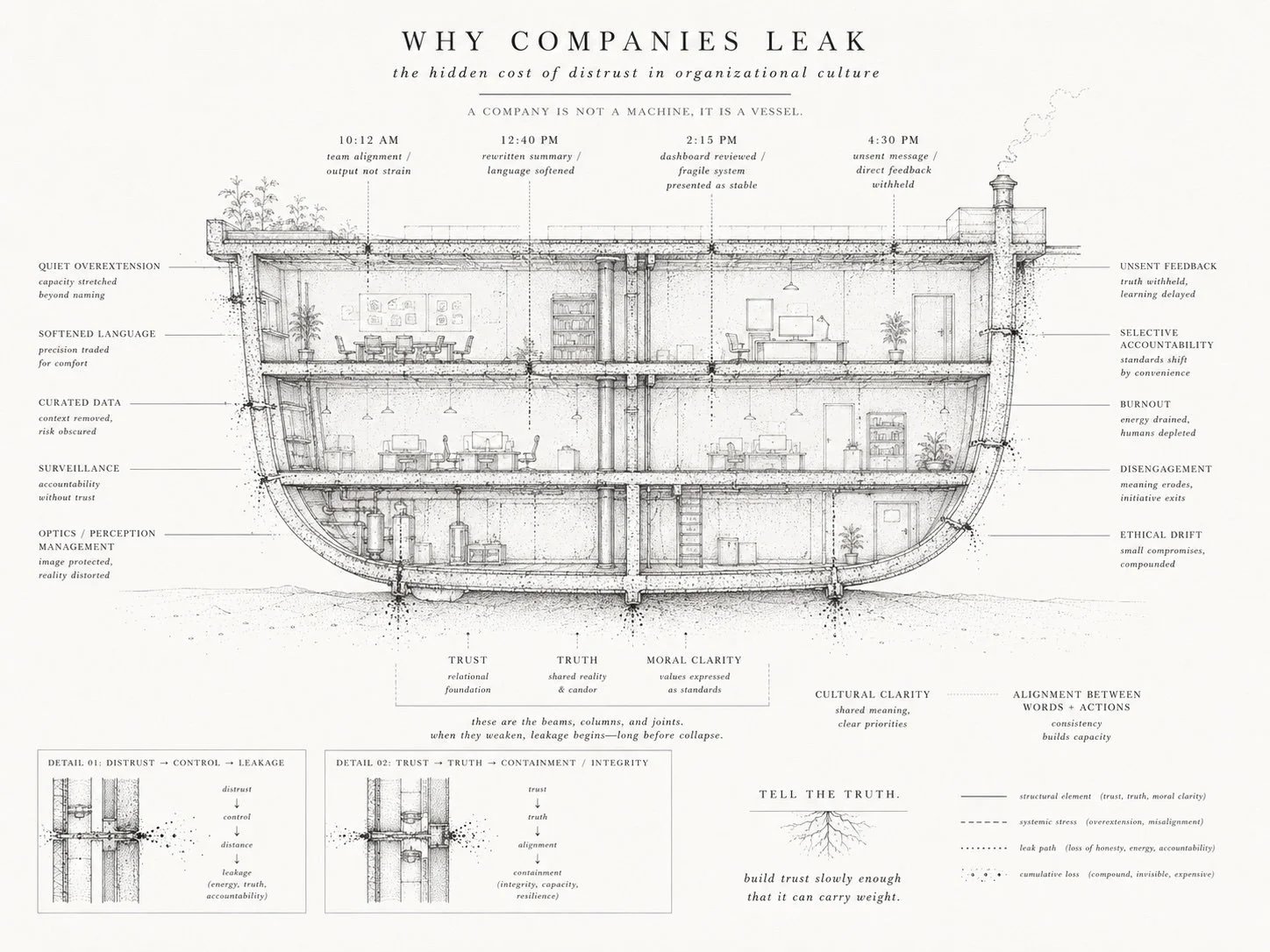
Companies do not leak the way we say they do.
Not through inefficiencies.
Not through missed targets or misaligned incentives.
Not through data dashboards.
Companies leak through what modern organizations struggle to measure:
trust, truth, and moral clarity.
A company is not a machine. It is a vessel.
Organizational culture is shaped by what it believes about people.
If a company believes employees cannot be trusted, it builds systems to contain them.
If it believes truth is flexible, it rewards those who bend it.
If it believes survival requires compromise, it normalizes quiet forms of theft: of time, energy, and integrity.
Eventually, leadership calls this organizational leakage.
But the leak began long before.
It began in the culture. It began with humans not units.
—
It’s a Tuesday morning inside a mid-sized company.
The kind of company that would describe its workplace culture as “collaborative” and “high-performing.”
At 10:12 AM, a team meeting begins.
The agenda is clear. The metrics are trending in the right direction. Leadership has already signaled what success should look like this quarter.
“We’re in a good place,” the manager says.
Heads nod across the screen.
No one mentions the tension sitting just beneath the update, that a key part of the system isn’t working as cleanly as reported. That timelines are being met, but only through quiet overextension. That the numbers reflect output, not strain.
In most organizations, this is what alignment looks like.
—
At 12:40 PM, an employee rewrites a project summary before submitting it.
Nothing dishonest. Just…adjusted.
Language softened.
Risks reframed.
Uncertainty translated into confidence.
They’ve learned this over time.
In this workplace culture, clarity is welcome. But only when it doesn’t disrupt momentum.
—
At 2:15 PM, a director reviews a performance dashboard.
The data is accurate, but the story is curated.
A small shift in presentation turns a fragile system into a stable one. A temporary fix reads like a sustainable solution.
This is not deception in the way companies train you to recognize it.
It is organizational instinct.
—
At 4:30 PM, a message is left unsent.
An employee considers giving direct feedback about a leadership decision, something that doesn’t feel aligned with the company’s stated values around trust and accountability.
They pause.
They’ve seen what happens to people who are “technically right” but poorly timed.
The message is deleted.
—
Nothing breaks.
No policy is violated.
No formal misconduct occurs.
No performance issue is flagged.
From the outside, the organization is functioning.
But across the day: effort is carefully measured, truth is selectively expressed, and trust is quietly negotiated instead of assumed.
This is how organizational culture shapes behavior.
Not through what is written in company values, but through what is safe to say, what is rewarded, and what is left alone.
—
This is what leakage looks like in everyday work.
Not dramatic loss.
But small, consistent exits of energy, honesty, and accountability.
A workplace where people do their jobs, but not with their full clarity.
Where leadership believes the system is working, because the system has learned how to report that it is.
And over time, the cost accumulates in the slow erosion of trust that no dashboard is designed to measure.
—
You can see it in hiring patterns.
Companies built on distrust attract people who have learned to protect themselves
from bad leadership,
from exploitative systems,
from environments where honesty is punished.
So they adapt.
They withhold effort.
They distort reality.
They take what they can.
Not because they lack character, but because the system trained them this way since they were young.
Organizations label this a performance issue. A culture problem. A lack of accountability.
But accountability without trust becomes surveillance.
And trust without truth becomes fiction.
So the leak expands.
—
Most companies respond the same way.
They optimize optics.
They manage perception.
They adjust metrics until the numbers tell a better story.
This is modern corporate strategy, manipulating graphs to move up and to the right, for stakeholders and public perception. Even for the company’s ego. Yes, companies have egos.
And for a time, it works.
You can manufacture performance.
You can simulate alignment.
You can convince stakeholders (and even your team) that everything is functioning.
But reality accumulates.
In burnout.
In disengagement.
In quiet quitting.
In ethical drift.
Eventually, the cost of distrust becomes visible.
—
We are told leakage is inevitable in business.
That inefficiency, disengagement, and ethical compromise are just part of scaling.
That without constant input — more control, more incentives, more pressure — organizations fail.
But this is not a law. It is a belief system.
Living systems offer a different model.
In regenerative environments, waste becomes nourishment.
Fermentation transforms what is discarded into what sustains.
Healthy soil improves over time through relationship, not extraction.
A company can function the same way.
Companies do not need to leak. It needs to be built on trust.
—
If you believe organizational leakage is unavoidable, you will justify the compromises required to manage it.
You will call them efficiency.
You will call them strategy.
You will call them realism.
And over time, they become your culture.
But if you believe something else
that intuition is valid,
that truth matters,
that trust is structural, not emotional
then you begin to see differently.
You begin to see where trust was first broken.
Where leadership stopped telling the truth.
Where accountability became selective.
And you repair from there.
Not with more control systems.
But with cultural clarity.
Not with more incentives.
But with alignment between words and actions.
Not with performance management frameworks.
But with truth that is consistently upheld.
—
The solution is simple.
Not easy. But simple.
Tell the truth.
Hold clear accountability.
Build trust slowly enough that it can carry weight.
This is what healthy organizational culture requires.
Not performative accountability.
Not leadership theater.
Not systems layered on top of distrust.
But a shared commitment to reality.
—
Companies that operate this way still face pressure. They still exist inside a broader economic system that rewards distortion and short-term gain. But they do not leak in the same way. Because their foundation is different.
They are built on people who trust what they are part of, and act accordingly.
That is not soft. It is structural.
And it is the only way a vessel holds.