Why Companies Leak: The Hidden Cost of Distrust in Organizational Culture
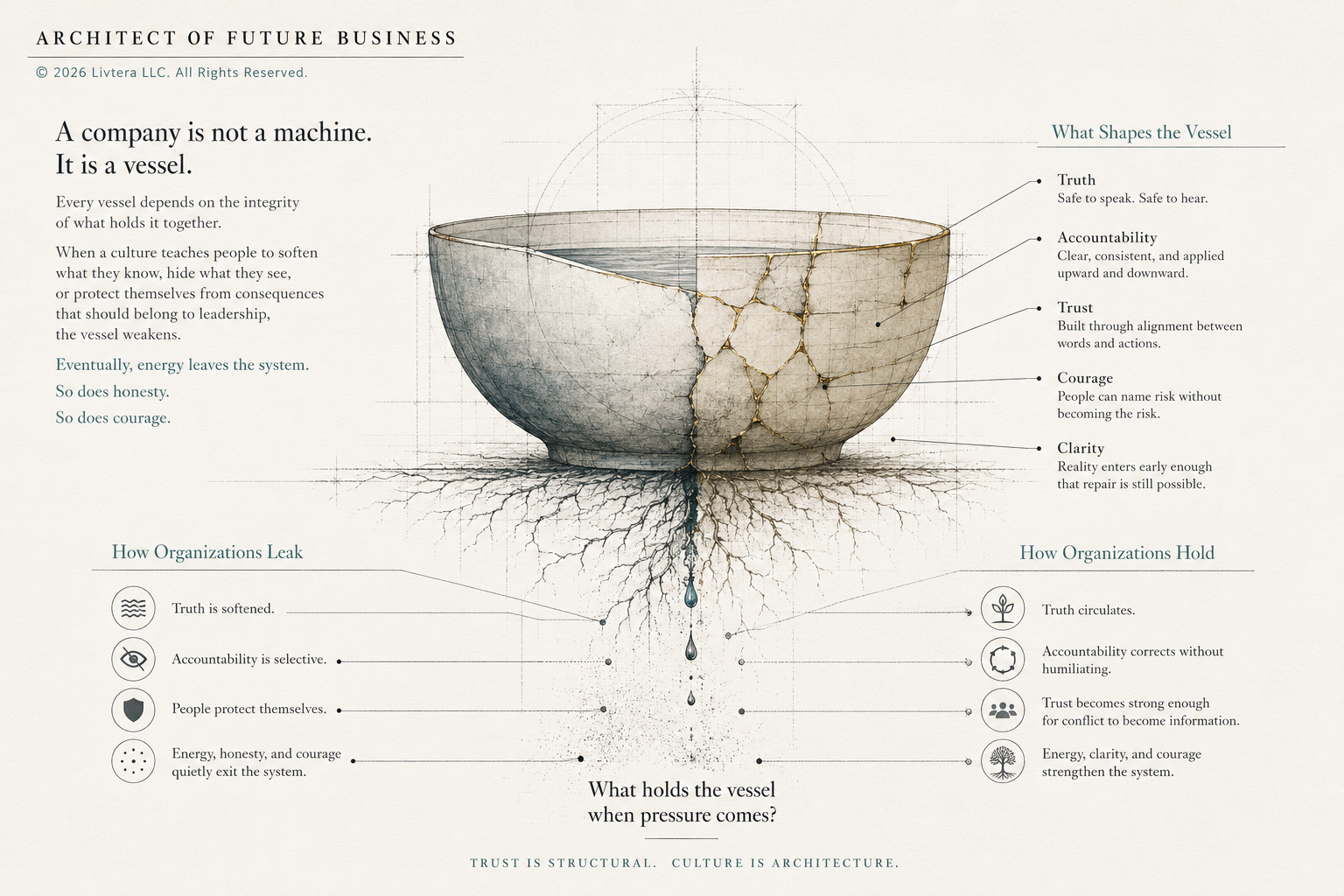
Companies do not leak the way we usually describe leakage.
The loss rarely begins with missed targets, misaligned incentives, or a dashboard turning red. Those are late symptoms. By the time a company can measure the leak, the deeper rupture has usually already happened.
Trust has thinned. Truth has become conditional. Moral clarity has been replaced by performance language.
A company is not a machine. It is a vessel. Every vessel depends on the integrity of what holds it together. When a culture teaches people to soften what they know, hide what they see, or protect themselves from consequences that should belong to leadership, the vessel weakens.
Eventually, energy leaves the system. So does honesty. So does courage. Leadership may call this inefficiency. The culture knows it as distrust.
A Company Is a Vessel, Not a Machine
Organizational culture is shaped by what a company believes about people.
If a company believes employees cannot be trusted, it builds systems to contain them. If it believes truth is flexible, it rewards those who bend it well. If it believes survival requires constant compromise, it normalizes quiet forms of theft: of time, energy, attention, and integrity.
These beliefs may never appear in the employee handbook. They live in the atmosphere. They shape meetings, emails, performance reviews, budgets, hiring decisions, and the private calculations people make before deciding whether to say what they actually think.
Eventually, leadership sees the consequences and calls them organizational leakage.
The leak began long before.
It began where truth became unsafe, where accountability became selective, and where humans were treated as units before they were treated as people.
A Tuesday Inside a Leaking Company
It is Tuesday morning inside a mid-sized company.
The kind of company that would describe its workplace culture as collaborative, high-performing, and mission-aligned.
At 10:12 a.m., a team meeting begins. The agenda is clear. The metrics are trending in the right direction. Leadership has already signaled what success should look like this quarter.
“We’re in a good place,” the manager says.
Heads nod across the screen.
No one mentions the tension sitting beneath the update. A key part of the system is not working as cleanly as reported. Timelines are being met, though only through quiet overextension. The numbers reflect output, not strain.
In many organizations, this is what alignment looks like.
Everyone agrees to describe the vessel as intact while water gathers at their feet.
When Truth Learns to Soften Itself
At 12:40 p.m., an employee rewrites a project summary before submitting it.
Nothing dishonest. Just adjusted. Language softened. Risks reframed. Uncertainty translated into confidence.
Over time, the employee has learned the culture’s rules. Clarity is welcome, provided it does not disrupt momentum. Concern is acceptable, provided it arrives with a solution. Truth can enter the room, as long as it is dressed as progress.
Later that afternoon, a director reviews a performance dashboard.
The data is accurate. The story is curated.
A small shift in presentation turns a fragile system into a stable one. A temporary fix reads like a sustainable solution. A team running on fumes becomes a team demonstrating resilience.
This is not deception in the way companies train people to recognize deception.
No one falsifies records, invents numbers, or explicitly lies. The behavior is subtler than that. It is organizational instinct. A culture learns what kind of truth it can survive. Then people edit reality accordingly.
The Message That Never Gets Sent
At 4:30 p.m., an employee considers sending direct feedback about a leadership decision. Something about the decision does not feel aligned with the company’s stated values around trust and accountability.
The message is written carefully. Then rewritten. Then paused over.
The employee has seen what happens to people who are technically right at the wrong time. Feedback can become a reputation risk. Clarity can be labeled negativity. A person can be praised for courage in public while quietly marked as difficult in private.
The message is deleted.
Nothing breaks.
No policy is violated. No formal misconduct occurs. No performance issue is flagged. From the outside, the organization is functioning.
Across the day, however, something has left the system.
Effort has been rationed.
Truth has been selectively expressed.
Trust has been negotiated instead of assumed.
This is how organizational culture shapes behavior. Not through what is written on the values page, but through what is safe to say, what is rewarded, what is punished without being named, and what everyone learns to leave alone.
What Organizational Leakage Really Looks Like
Organizational leakage is rarely dramatic at first.
It is the slow exit of energy, honesty, courage, attention, and accountability.
A workplace can keep operating while this happens. People attend meetings. Projects move forward. Reports get filed. Goals appear on track. The company receives compliance and mistakes it for commitment.
The leak hides inside politeness. Inside vague updates. Inside over-functioning. Inside the employee who has stopped offering their best thinking because the organization has shown no real appetite for reality.
Leadership may believe the system is working because the system has learned how to report that it is. Over time, the cost accumulates in ways no dashboard is designed to measure.
Not only turnover, burnout, or missed goals. The deeper cost is cultural: people no longer trust that truth will be held well. Once that happens, the organization may still have talent, strategy, and resources. What it loses is the shared reality required to use them wisely.
Distrust Creates the Behavior It Fears
Companies built on distrust often create the behavior they claim to be managing.
When people feel watched more than trusted, they learn to protect themselves. When accountability flows downward but rarely upward, they become careful with their honesty. When leadership rewards polish over truth, they learn to curate reality before presenting it.
Some withhold effort, distort risk, save their best thinking for somewhere safer, take what they can because the organization has taught them that loyalty is not mutual. This does not always come from poor character. Often, it comes from adaptation.
Organizations then label the result a performance issue, a culture problem, or a lack of accountability. More oversight follows. More reporting. More metrics. More pressure. The company tightens control to prevent the behavior its distrust helped produce. Accountability without trust becomes surveillance. Trust without truth becomes fiction. Neither can hold a company together.
The Dashboard Cannot Measure the Vessel
Most companies respond to leakage by optimizing optics.
They manage perception. They adjust metrics until the numbers tell a better story. They build dashboards, refine internal messaging, smooth executive updates, and explain reality in ways that preserve confidence.
This is modern corporate strategy at its most fragile: manipulating graphs so they move up and to the right for boards, investors, funders, stakeholders, public perception, and the company’s own ego.
Yes, companies have egos.
For a time, this can work. Performance can be manufactured. Alignment can be simulated. Stakeholders can be convinced that everything is functioning. Sometimes even the team begins to believe the story because the alternative would require too much disruption.
Reality still accumulates.
It accumulates in burnout.
In disengagement, quiet quitting, ethical drift, exhaustion of people who have learned to say less than they know. Eventually, the cost of distrust becomes visible. By then, leadership may call it leakage, inefficiency, or execution failure. The dashboard may show the symptom. It cannot measure the vessel.
Control Does Not Repair Distrust
We are often told that leakage is inevitable in business.
Inefficiency, disengagement, and ethical compromise are treated as the natural cost of scaling. Without constant input — more control, more incentives, more pressure, more monitoring — organizations assume people will drift.
This is not a law. It is a belief system. Belief systems become architecture.
A company that believes people cannot be trusted will build a structure that proves itself right. A company that believes truth is dangerous will reward those who make truth palatable. A company that treats accountability as control will produce compliance without courage.
Over time, the compromises acquire respectable names.
Efficiency. Strategy. Realism. Maturity. Leadership.
The culture slowly becomes fluent in its own distortion.
Living Systems Hold Differently
Living systems offer a different model.
In regenerative environments, waste can become nourishment. Fermentation transforms what might be discarded into what sustains. Healthy soil improves over time through relationship rather than extraction.
The point is not that nothing is lost. The point is that what moves through the system can be metabolized.
Energy circulates. Truth circulates. Correction circulates. Accountability circulates.
A healthy company does not prevent all tension. It learns how to metabolize tension without lying about it. Conflict is not eliminated. Trust becomes strong enough for conflict to become information rather than threat. A healthy culture does not demand constant positivity. It allows reality to enter early enough that repair is still possible.
Companies do not need to leak in the same way. They need to be built on trust strong enough to hold truth.
Trust Is Structural
Trust is often treated as an emotion. A vibe. A leadership value. A sentence in the employee handbook.
Trust is structural. It is built through repeated alignment between words and actions. It grows when leaders tell the truth before the truth becomes unavoidable. It strengthens when accountability applies upward, not only downward. It deepens when people can name risk without becoming the risk.
Trust becomes real when feedback does not require political calculation before it can be spoken. A company that understands this begins to see leakage differently. It looks for the first place trust broke. It studies where leadership stopped telling the truth. It notices where accountability became selective. It asks where people learned to protect themselves from the organization they were supposed to help build. Repair begins there. Not with more control systems. With cultural clarity. Not with stronger incentives. With alignment between words and actions. Not with performance management theater. With truth that is consistently upheld.
How a Company Begins to Hold
The solution is simple. Not easy. Simple.
Tell the truth. Hold clear accountability. Build trust slowly enough that it can carry weight.
Healthy organizational culture requires more than performative accountability, leadership theater, or systems layered on top of distrust. It requires a shared commitment to reality.
Companies that operate this way still face pressure. They still exist inside an economic system that rewards distortion, speed, and short-term gain. They still make mistakes. They still experience conflict. They still have to make hard decisions.
The difference is that they do not leak in the same way. Their foundation is different.
People trust what they are part of, so they act with more clarity inside it. Truth can move through the system without being treated as a threat. Accountability can correct without humiliating. Leadership can receive reality without punishing the person who named it.
That is not soft. It is structural. It is the only way a vessel holds.