Good Things Do Not Happen to Good People, Part I: Conditions
Good things do not happen to good people.
I wish they did. It would make the world easier to explain.
Work hard. Be kind. Tell the truth. Keep your promises. Take care of your family. Do not exploit people. Become excellent at your craft. Then wait.
The good life will arrive because faithfulness is The Way.
This is one of the first moral equations many of us are given. We hear versions of it in sermons, meritocracy, karma, professionalism, manifestation, personal responsibility, positive psychology, and the American dream. Different traditions, similar model:
If I become good enough, perhaps the world will become good to me.
Reality has made no such agreement.
People who love their children lose their houses. People who work seventy hours a week cannot afford dentistry. Extraordinary people spend their careers beneath people with greater access and less discipline. Good founders lose companies. Honest employees get fired. Competent people become ill. Children inherit consequences they did not create.
A person can do nearly everything we tell people to do and still arrive at a life that their culture — and sometimes their own family — interprets as evidence they did something wrong.
That possibility frightens us because if goodness does not reliably produce good outcomes, character can no longer explain the whole story.
We have to look at conditions.
We Have Confused Morality With Outcomes
In 2025, 37 percent of American adults told the Federal Reserve they could not cover an unexpected $400 expense entirely with cash or its equivalent. 12 percent said they could not pay it by any means. 26 percent went without some form of medical care because they could not afford it, while nearly one in five adults carried debt from their own medical care or that of a family member.
These are not isolated failures among people who neglected to work hard enough. They are ordinary events occurring inside one of the wealthiest societies ever constructed.
Nearly half of Americans between 19 and 29 received financial help from someone outside their household in 2025. The money paid for rent, utilities, cars, medical bills, and general living expenses. Our mythology says adulthood begins when dependency ends. Our economy has other ideas.
This creates uncomfortable questions across political identities. Personal responsibility matters, but responsibility requires some margin in which to operate. Social provision matters, but merely administering an expanding inventory of suffering is not the same thing as designing a society that produces less of it. Neither abstraction is particularly useful when the refrigerator breaks and a parent has fourteen dollars until payday.
Reality is embarrassingly indifferent to ideology. It keeps sending invoices.
Your ZIP Code Is Not Your Character
The research becomes even harder to reconcile with our moral mythology when we look at children.
Researchers behind the Opportunity Atlas examined millions of American lives and found dramatic differences in adult outcomes depending on where children grew up. Their work attempts to separate the effect of the neighborhood itself from the kinds of families who happen to live there.
For a child growing up in a low-income family, Opportunity Insights estimates that moving within the same metro area from a below-average to an above-average neighborhood in upward mobility would increase lifetime earnings by approximately $200,000.
Same child.
Different conditions.
Different life.
We tend to call the first outcome potential fulfilled and the second potential wasted, as though potential were an entirely internal substance a person either deployed correctly or failed to use.
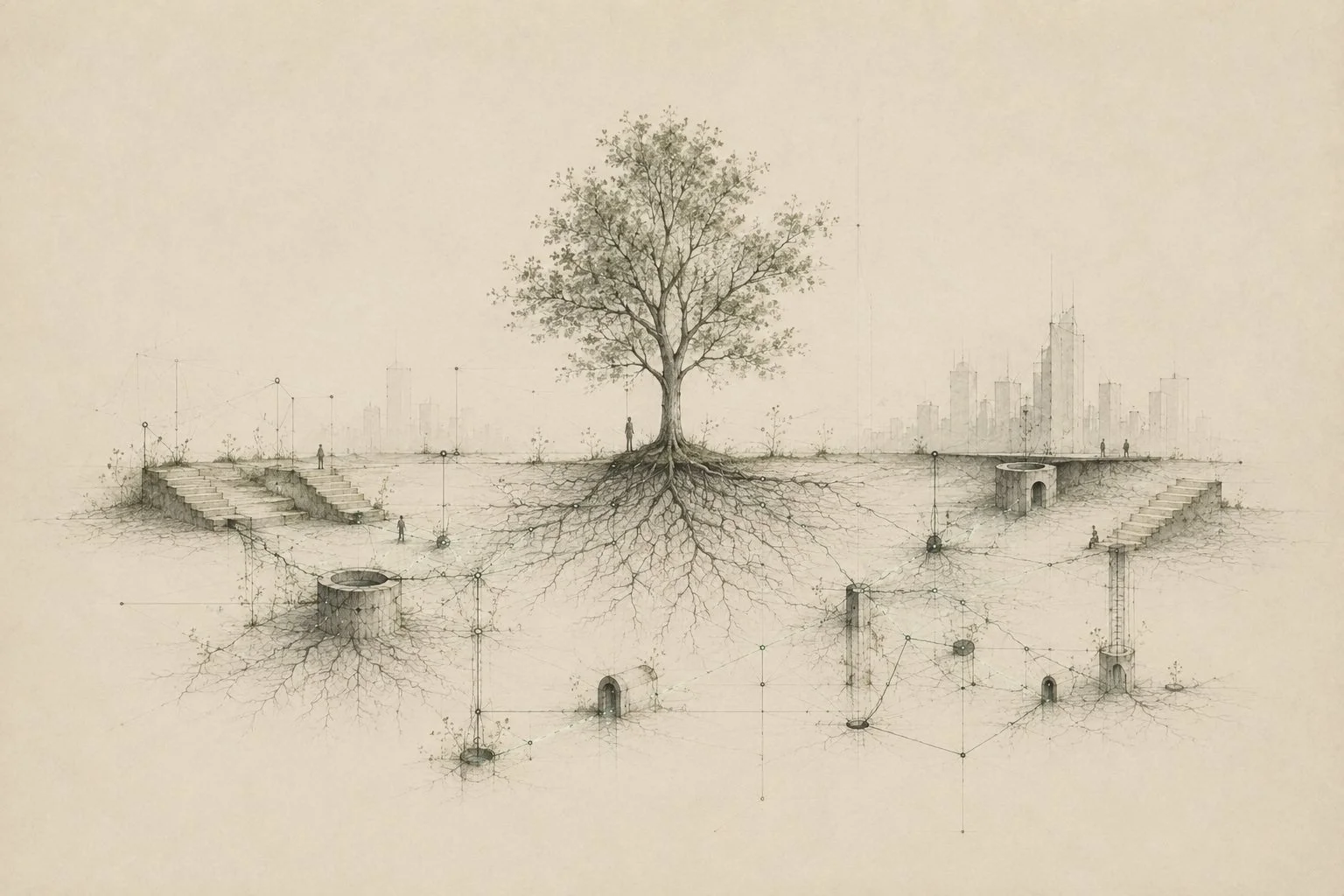
But potential behaves more like a seed.
A seed planted in depleted soil has not committed a character defect. It does not need a better morning routine. Affirmation will not change the nitrogen content of the ground.
This is where much of our language about work becomes cruel without intending to. The struggling employee needs resilience. The poor family needs financial literacy. The burned-out physician needs mindfulness. The founder needs better time management. The child needs grit.
The diagnosis keeps moving inward even when the cause does not.
Conditions Change the Price of Agency
None of this eliminates personal responsibility.
The writer still has to write. The founder still has to make decisions. The athlete still has to train. The employee still has to become competent. A seed still contains instructions.
But conditions determine how expensive those instructions become to execute.
Imagine two people leaving destructive employers. One has six months of savings and parents with an extra bedroom. The other has two children, no health insurance, and rent due in twelve days. We can call both decisions courage. They are not economically equivalent forms of courage.
This distinction matters because we often look backward from an outcome and assign moral meaning to whatever we find. The person who survived was disciplined. The person who did not was irresponsible. The person who became wealthy took risks. The person who became poor made bad choices. Sometimes those explanations are true. Sometimes, perhaps more often than not, they are the story the surviving system tells about itself.
Goodness offers no contract with reality. You can be kind and judged, brilliant and undiscovered. You can build something people need and lose it because capital did not arrive during the six months when survival required it. You can love someone well and still bury them.
There is no cosmic customer-service department where we submit our justice invoice.
That is not nihilism, however, it is ecology.
Leadership Is the Design of Conditions
Anyone responsible for an organization is designing conditions whether they acknowledge it or not.
Compensation alters the soil. So do schedules, health insurance, parental leave, decision rights, mentoring, information flow, and who is permitted to make mistakes without acquiring a permanent reputation.
So does attention.
Who gets interrupted? Who gets believed? Whose anger becomes leadership and whose becomes instability? Who receives mentoring because someone powerful recognizes themselves in them? Who slowly disappears because nobody does?
Culture is not what an organization believes about itself. Culture is what happens repeatedly to people inside it.
That makes human conditions an economic question, not merely a humane one. An institution that systematically consumes the conditions required for good judgment, creativity, health, trust, and competence will eventually consume its own productive capacity.
There is no guarantee that good things will happen to good people. No economic system can eliminate illness, grief, storms, bad timing, failed businesses, or the ordinary brutality of chance.
The task is smaller than cosmic justice and more demanding than motivational language.
We can stop manufacturing preventable suffering and calling the survivor resilient. We can build workplaces where one emergency does not destroy a household. We can make excellence possible without requiring exhaustion as evidence of commitment. We can build institutions that distinguish poor conditions from poor character.
We cannot control the weather of a human life. We control far more of its architecture than we pretend.
That is the work. Not becoming good enough to deserve a better world.
Building conditions in which more people have a chance to live well inside this world.