On reciprocity, ideas that travel, and what our institutions could learn to count.
An investor once told me something he thought would make me happy.
He had shared one of my ideas with another founder, who liked it so much he built a presentation around it for his staff.
"Isn't that amazing?" he asked.
I remember how difficult it was to agree.
We had spent months imagining a different economy together. Not only new businesses. Whether investment itself could carry the values we kept describing. In one of our first conversations, I had offered him the idea he was now so pleased to see in circulation.
That profit, in its fullest sense, is about relationship.
And here it was, traveling without one.
What a Maple Counts
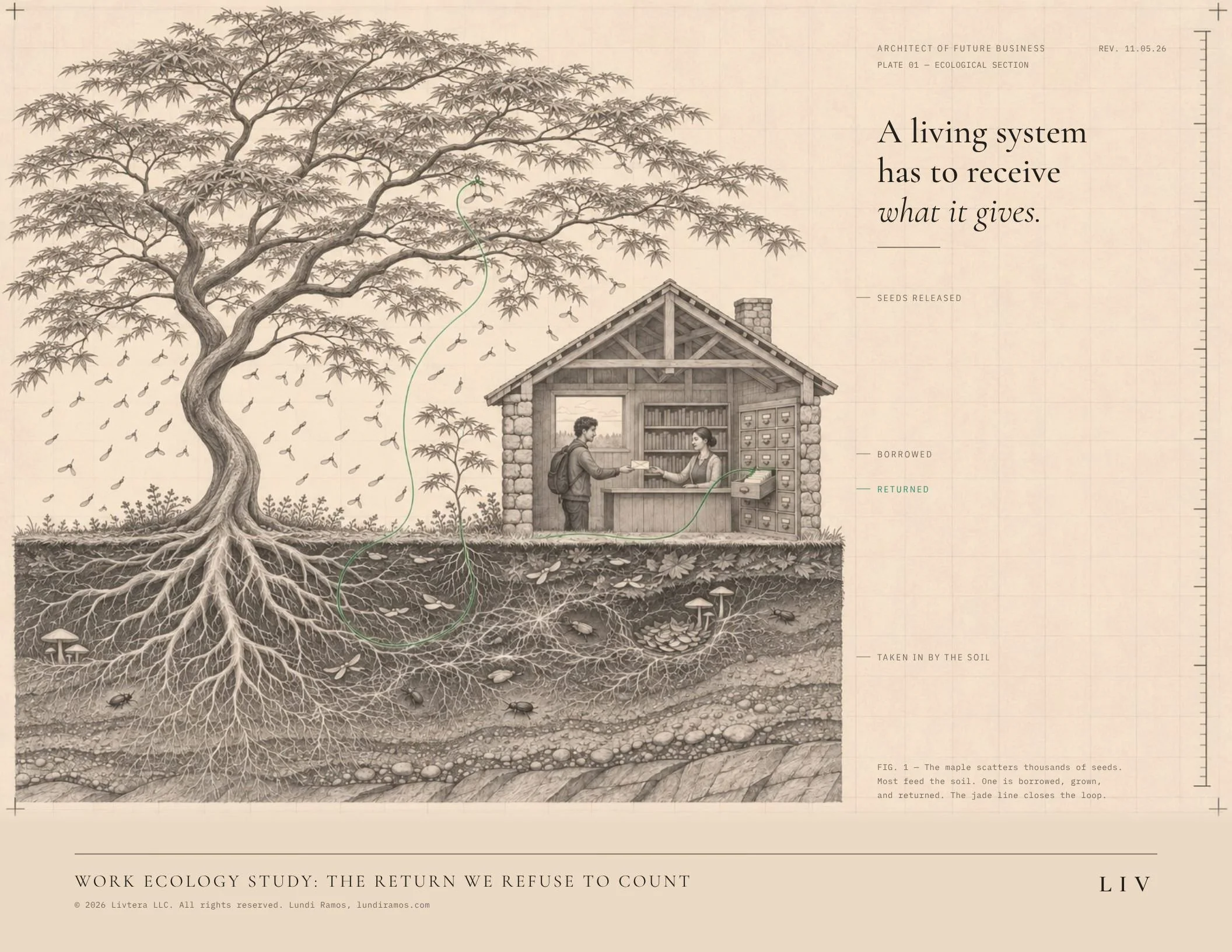
I had explained the idea with a Japanese maple.
A mature tree releases thousands of seeds. Very few become trees. Measure the maple by that conversion rate and it looks like a poor investment.
But the seeds that never become trees are not lost. They feed birds and soil and the slow work underground that no one sees. The tree shades what grows beneath it and changes the conditions for everything nearby.
It is nourished by an ecology it also nourishes.
A spreadsheet would call most of that waste. The spreadsheet is not lying. It is answering a smaller question than the one we are living inside.
I have spent much of my adult life keeping organizations solvent, so I do not say this lightly. Money matters. But every financial statement begins with a decision about what deserves to be counted, made before a single number is entered.
A company can raise its margins by exhausting its people, or by moving its costs onto those with no power to refuse them. The return is real.
So is everything the calculation left out.
A ledger is a theory of what matters, written in numbers.
The Part of the Story About Me
I wanted something from that exchange, too.
I wanted to be recognized. I wanted the investor to see the value of what I had offered before someone he already admired confirmed it.
Some of that was ego. Some of it was the ordinary wish to have a contribution acknowledged. I am still learning to tell them apart.
What I noticed, standing there, was that I had been arguing for a fuller account of value while hoping to be valued by the old one. The economy I was criticizing was not only around me.
It was in me.
I think this is where many of our new economies stall. We describe interdependence beautifully, then keep score the way we were taught. Generosity becomes a virtue we expect most from the people with the least room to practice it. We praise the person who keeps giving under worsening conditions, and call the depletion commitment.
There is nothing ecological about endless depletion.
A living system has to receive what it gives.
A Library That Lent Seeds
Some of the best answers I have found are small and a little unglamorous.
More than a decade ago, the public library in Basalt, Colorado, began lending seeds. Borrowers took a packet home with their library card, grew the plants, let a few of the strongest go to seed, and brought those seeds back so the library could lend them to someone else. Other libraries have started seed libraries of their own.
The practice is old. For most of human history, farmers kept seed this way, saving from the plants that did best and passing it on. Every borrower is also a supplier. The collection survives only if what goes out comes back, and it grows stronger when what comes back has adapted to local ground.
Nothing about this is charity. No one is asked to give without receiving, and no one receives without being asked to return.
It was a small institution building reciprocity into its circulation desk.
The return is part of the loan.
What a Returning Institution Would Count
I keep imagining a workplace that runs on that logic.
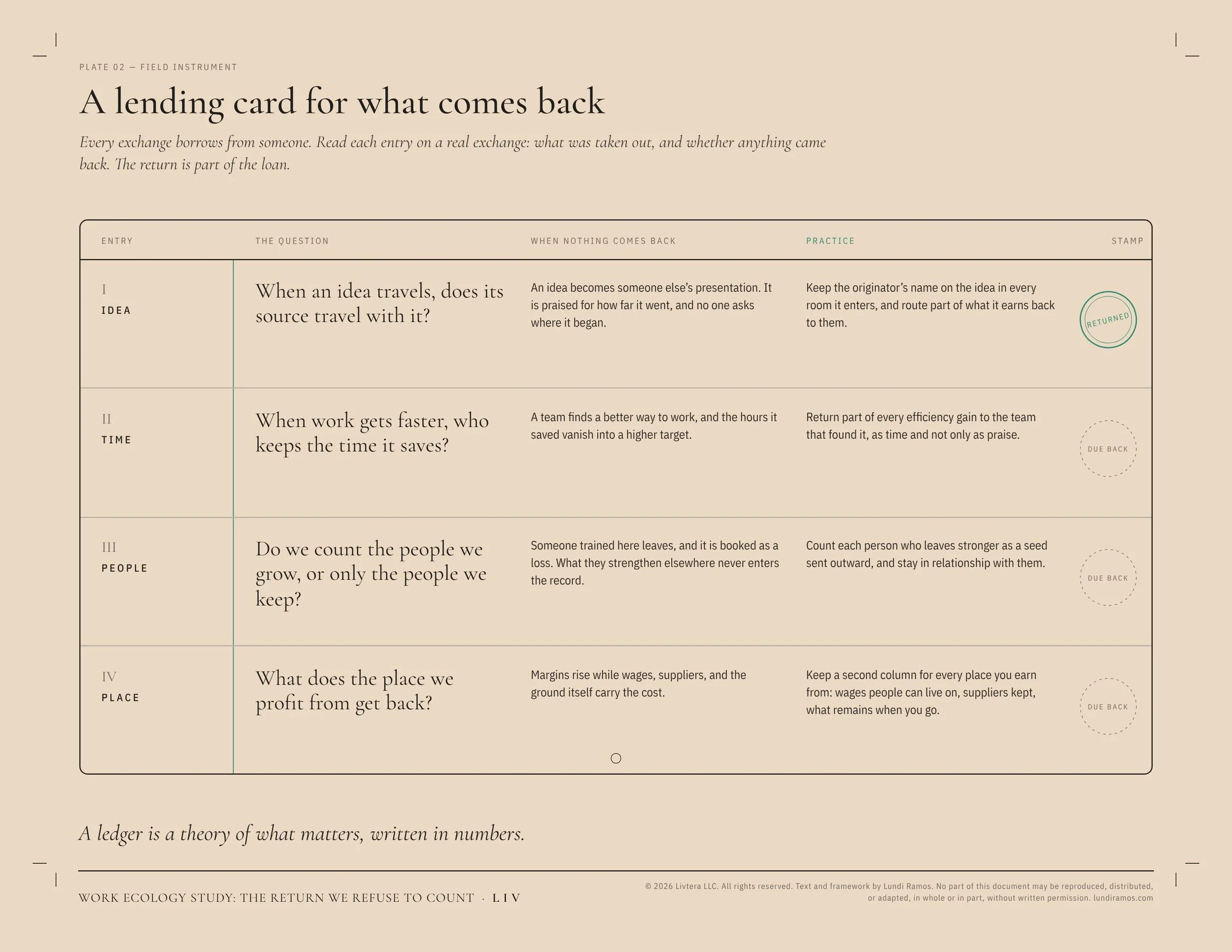
It would change the question it asks of every exchange. Beside what something produced, it would record what went back to the people and places that made it possible. A second column, kept as carefully as the first.
When an idea moves through the organization, the person it came from moves with it. Their name stays on it in the room where it is presented, and some part of what it earns finds its way back to them.
A team that finds a better way to work keeps part of the time it saves, instead of watching it disappear into a higher target.
When someone the organization trained leaves for another place, it counts a seed sent outward, not a loss. Many of the best people in any field were grown somewhere else first.
When a business profits from a town, it asks what the town gets back: wages that let people live there, suppliers it keeps, what it leaves in the ground when it goes.
None of this requires abandoning the spreadsheet. It requires a fuller one.
This matters more as our tools improve. Ideas will travel faster than ever, through more hands and more software, and it will be easier than ever to lose track of where they came from and what they cost. The future of work will be shaped by what our systems can produce. I suspect it will be decided by whether they can give back.
What I Want to Know Now
I still hope that founder's presentation did something good. Perhaps someone treated an employee differently because of it. That would be a real return.
But I am less interested now in how far an idea travels.
I want to know what it leaves behind, and what comes back.
The maple does not keep count. It does not need to. The forest keeps it, season after season, in what grows.
Our institutions will have to learn to keep that count on purpose.
Research Behind This Essay
The following reporting and examples inform the essay's examination of reciprocity and what institutions choose to count. They describe practice rather than prove a theory; none independently establishes the broader Work Ecology framework.
NPR (2013). How to save a public library? Make it a seed bank. The Salt.
https://www.npr.org/blogs/thesalt/2013/02/02/170846948/how-to-save-a-public-library-make-it-a-seed-bank
Reporting on the Basalt Regional Library's seed library in Colorado, where patrons borrowed seeds with a library card, grew them, and returned seed from their strongest plants.
Concord Free Public Library (n.d.). Concord Seed Lending Library: How it works. Library program page.
https://concordlibrary.org/borrow/library-of-things/concord-seed-lending-library/how-it-works
A current example of the borrow, grow, save, and return cycle that keeps a seed collection alive.