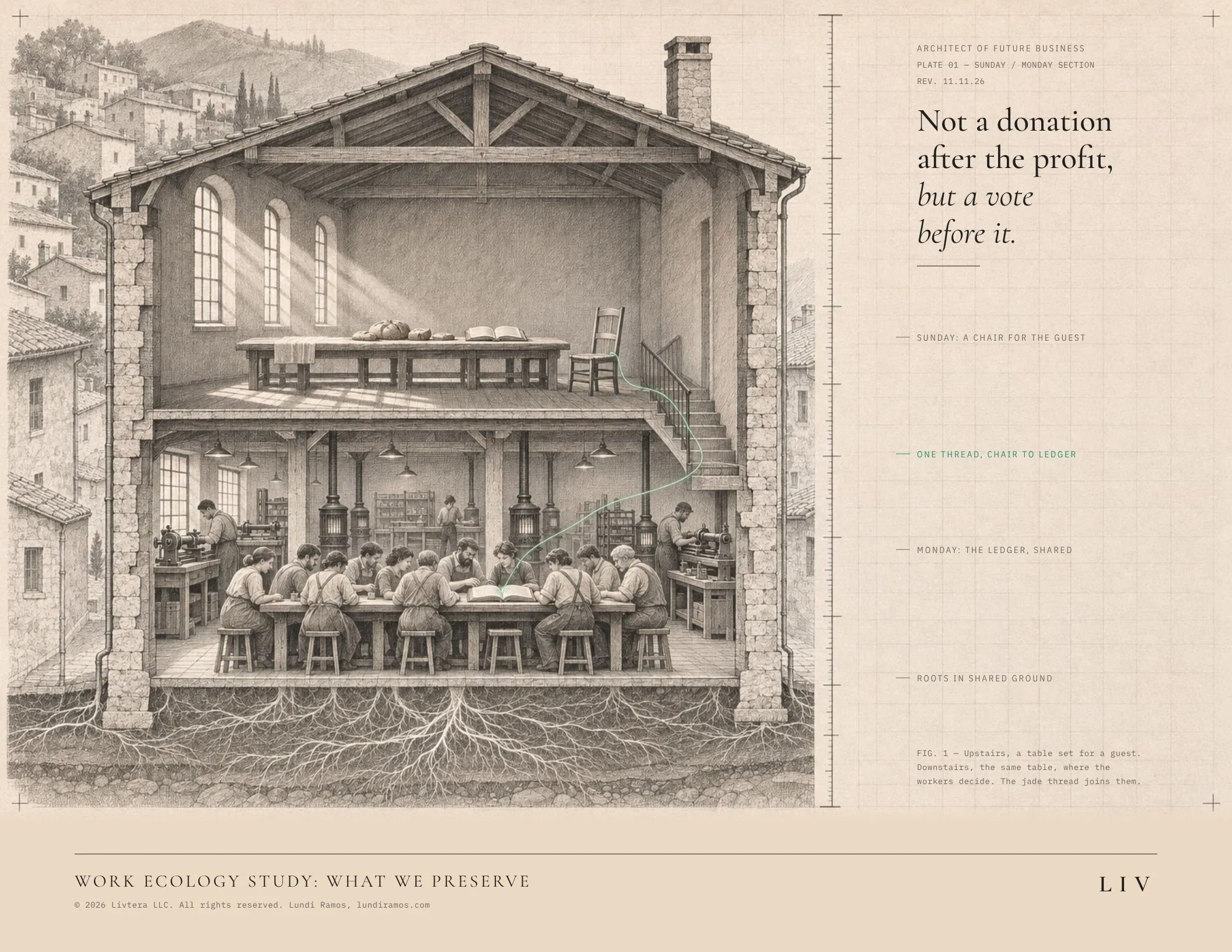
On Sunday ethics, Monday economics, and what our institutions are built to preserve.
I remember being young enough to expect Sunday to survive into Monday.
Our church was going through a series on loving your neighbor. We were taught to consider the widow, the orphan, and especially the outcast. To recognize the person whose survival depended on someone else making room.
Then Monday arrived.
In the coffee line, I overheard stories about cornering the market and dominating the competition. The satisfaction was unmistakable. I was still learning what I was expected to admire.
A Bible lay on the table beside a steaming cup.
I did not yet have the language to ask where the neighbor had gone.
The wealth that sustained the church's care for the widow and the orphan was often built through practices its sermons left unexamined. Some of the same people understood generosity as a sacred obligation and dominance as evidence of a life well managed.
Most of them experienced no contradiction between the two.
That was what unsettled me.
The contradiction required no concealment and prompted no accountability. It could be spoken aloud, on consecutive days, by people who understood themselves to be good.
An ethic, I learned, could travel a long way without ever being allowed into the room where money was made.
That room had an ethic of its own.
Preserve yourself. Provide for your own. Secure enough that you will never depend on someone else making room.
The neighbor mattered. When the neighbor's needs threatened our security, another obligation took precedence.
I began to wonder how much of our goodness depended on never having to choose.
When Goodness Fails to Protect Us
People drawn to this work often want two things. They want to see more good in the world, and they want to understand why the world has not been good to them.
I recognize both desires. For years, I could barely separate them.
Someone works diligently, tells the truth, stays loyal when leaving would have been easier. The diligent person becomes useful to someone less diligent. The loyal person becomes easy to keep without care. The truthful person becomes a problem in a room organized around an omission.
There is a particular disorientation in discovering that the quality an institution praises is the quality it has learned to exploit.
I had mistaken a promise about the world for a description of how it worked.
The Room the Sermon Never Entered
A business can remain remarkably composed while its workers reorganize their lives around its changing needs. From the executive office, this looks like excellent management. From inside a household, it looks like another canceled appointment, another month in which the body absorbs what the balance sheet will not.
The disorder has not disappeared. It has changed addresses.
I would be careless to make self-preservation the enemy. For someone living under violence or poverty, preserving the self may be the most necessary work there is. The person protecting a meal and the person protecting a margin can both say they have no choice.
We should be able to hear the difference.
On Monday, the neighbor became a competitor, a labor expense, a tenant, a debtor. Later, some portion of the proceeds could return to the church. The giving was often sincere. But charity leaves a particular authority intact. The giver decides how much, to whom, and on what terms, and the arrangement that made others depend on that generosity stays where it was.
We know how to honor the donor. We are less practiced at asking whether the donor's workers can afford to live.
That question follows the money back into the room the sermon never entered.
A Priest Who Entered It
In 1941, a young Catholic priest named José María Arizmendiarrieta arrived in Mondragón, a town in the Basque Country of Spain.
He did not stay in the pulpit. He started a technical school. In the mid-1950s, a handful of his former students opened a small workshop making paraffin heaters, owned by the people who worked in it.
That workshop became the first of the Mondragon cooperatives. In 2024, they employed more than 70,000 people.
What stays with me is not the size. It is where he chose to put the Sunday teaching.
In the cooperatives, the worker-owners vote on how much the highest-paid person may earn compared with the lowest. Across them, the gap has ranged from about three to one to nine to one. The question the sermon never asked about the money gets asked anyway, in a meeting, by the people the money comes from.
It is not a utopia. Some cooperatives have voted to leave. Many people working in Mondragon businesses are employees, not owners. Every structure carries its own shadow.
But it shows something I spent years wanting to see. The neighbor can be written into the terms. Not as a donation after the profit, but as a vote before it.
Sunday does not have to wait outside the door.
What My Own Goodness Must Survive
Those of us who want a better world have our own version of this problem.
We can need to be the one who cared, the one whose intentions should place us beyond examination. Then criticism begins to feel like desecration. I have seen mission become a shelter from accountability. Founders are susceptible to this, and I am not exempt.
What I have given cannot become the reason I no longer have to listen.
But listening is not enough. It takes something more durable than my willingness. People need ways to challenge a decision that do not depend on the goodwill of the person being challenged. That is what a vote in Mondragón is, at its best. A structure that keeps listening when the founder is tired, or gone.
An ethic that cannot survive correction will eventually require someone else to carry its errors.
Building Something Worth Preserving
Our goal cannot be to right a wrong world if that means waiting for everyone to agree on who was good. The people who benefited from an arrangement may never consent to an accurate description of it.
We can pursue justice without making their recognition the condition of our freedom.
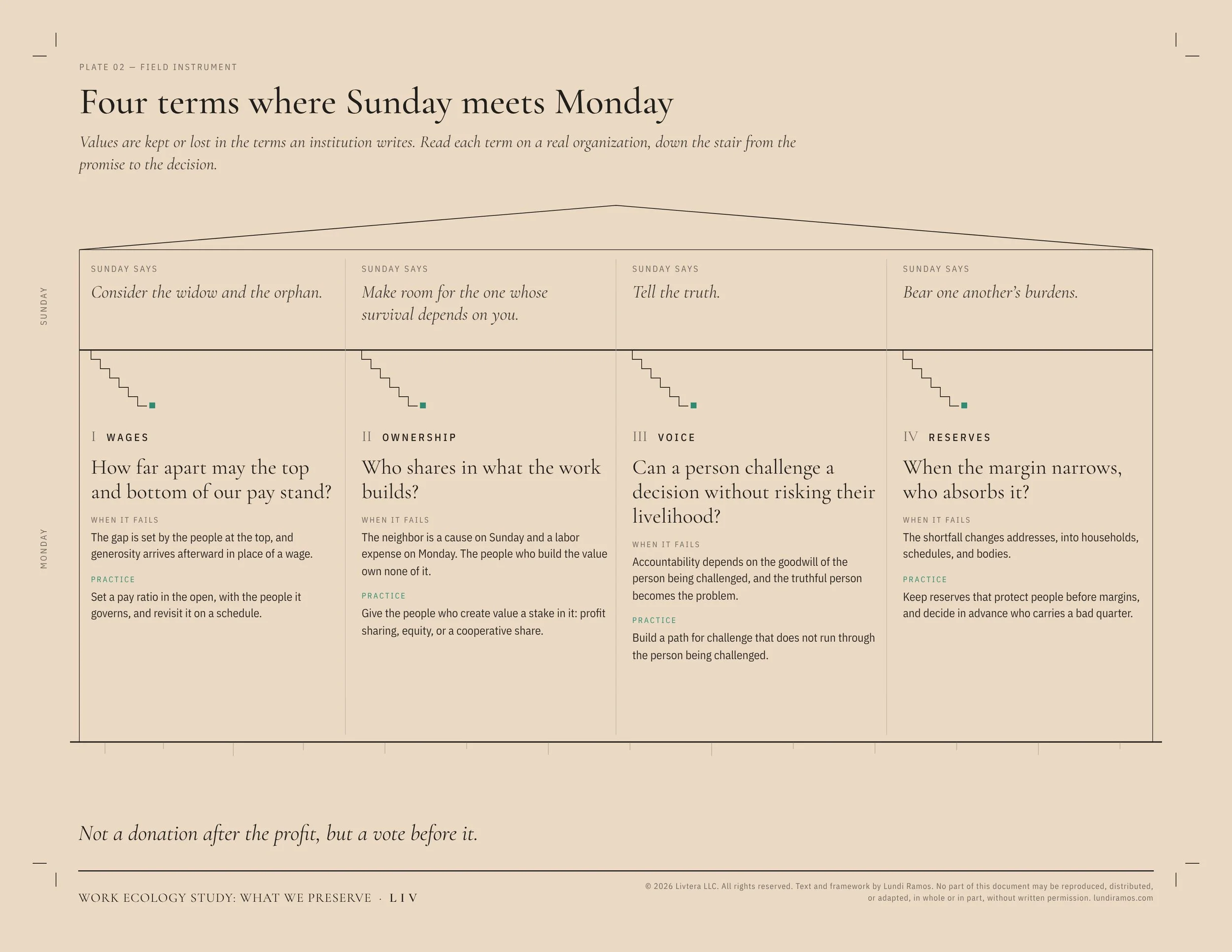
This is where I want the work to go: into the ordinary terms through which an institution preserves itself. Someone absorbs every shortfall. The question is who. A person either can challenge a decision without risking their livelihood, or cannot. The answers live in wages, ownership, reserves, grievance procedures, and who holds the vote.
Some institutions are worth preserving. Others are only skilled at preservation.
A priest in a poor town decided the difference was worth building. It did not take perfect people. It took terms that held when the people were imperfect.
I no longer expect goodness to guarantee that the world will be good to me. I do expect it to change the terms I am willing to build.
The neighbor is still present when the negotiation begins. Still present when the margin narrows.
The work is to write the neighbor into the terms.
Something Sunday can survive inside.
Something Monday must answer to.
Research Behind This Essay
The following history informs the essay's examination of how an ethic can be written into the terms of ownership and pay. Cooperatives vary widely; this example illustrates one path and does not independently establish the broader Work Ecology framework.
Mondragon Corporation (n.d.). All our history. Mondragon Corporation.
https://www.mondragon-corporation.com/en/history/
The cooperative group's own account of its origins: Father José María Arizmendiarrieta's arrival in Mondragón in 1941, the technical school, and the first cooperative workshop of the mid-1950s.
Wikipedia contributors (n.d.). Mondragon Corporation. Wikipedia.
https://en.wikipedia.org/wiki/Mondragon_Corporation
An overview of the cooperatives' governance, including pay ratios set by worker-owner vote and a workforce of more than 70,000 in 2024.