On maintenance, invisible labor, and the people who keep institutions alive.
In 1969, a young artist in New York had a baby and discovered that her life had become a list of tasks no one considered art.
Diapers. Dishes. Feeding. Cleaning. Repetition without completion. Mierle Laderman Ukeles had been making work meant to be seen. Now she spent her days doing work whose entire purpose was to vanish. A clean floor shows nothing. It only reveals, by its absence, the dirt that was never allowed to stay.
So she wrote a manifesto. She divided human effort into two systems. Development was the new: invention, change, progress. Maintenance was everything that kept the new alive, the daily labor, in her words, to "keep the dust off." Then she asked the question that has never quite left the culture of work:
After the revolution, who's going to pick up the garbage on Monday morning?
Nearly a decade later, she answered herself. Over almost a year, beginning in July 1979, she walked the routes and garages of the New York City Department of Sanitation and shook hands with more than 8,500 of its workers. To each one she said the same sentence.
Thank you for keeping New York City alive.
In a city that called them garbagemen, it was not a small sentence.
She has held the title of artist-in-residence at the Department of Sanitation since 1977. The position is unsalaried.
The city's most faithful witness to its maintenance has done that work, too, without a salary.
The Work That Disappears When It Succeeds
Every institution runs on two economies.
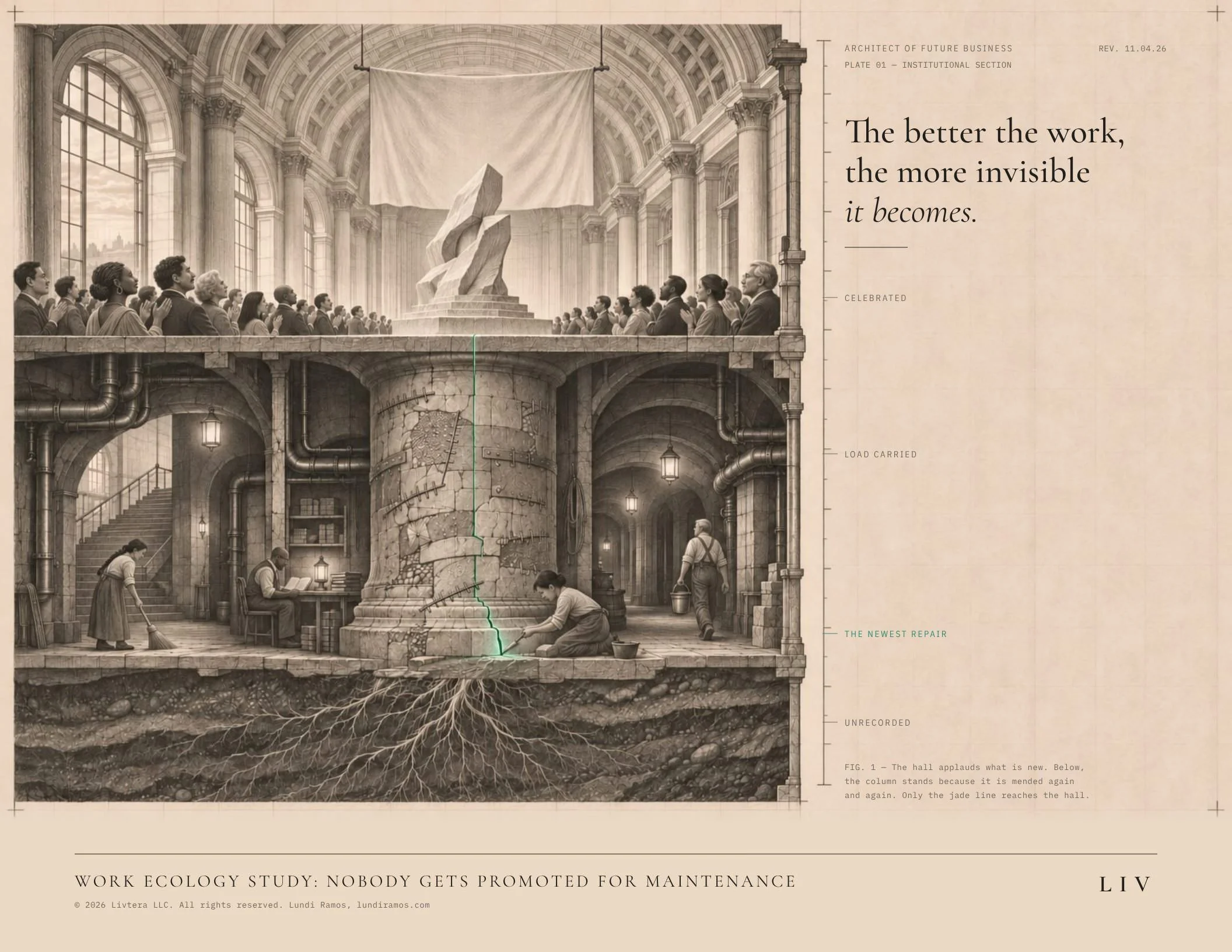
One is visible. It has launches, announcements, new programs, rebrands, and a person standing in front of a slide. It produces events. Events can be photographed, credited, and placed on a résumé.
The other is continuous. The accounts get reconciled. The confused email is answered before it becomes an angry one. The procedure is rewritten after the third mistake, and the new hire learns what the procedure leaves out. Somebody notices that a colleague has stopped eating lunch.
This economy produces non-events. Nothing broke. The audit was uneventful.
Success in maintenance looks exactly like nothing happening. That is its burden. An organization learns to see through effort in proportion to how well the effort is done.
The better the work, the more invisible it becomes.
Nobody Ever Gets Credit
In 2001, two researchers at MIT, Nelson Repenning and John Sterman, published a study of why improvement programs so often fail inside companies that sincerely want them. Their title said it plainly: Nobody ever gets credit for fixing problems that never happened.
What they found was a trap with a slow fuse.
When performance slips, managers have two options. People can work harder, or the organization can invest in the capability of its processes: training, repair, maintenance, the unglamorous time it takes to make the work itself better. Working harder pays immediately. Investing pays later, and only if someone protects the time long enough for it to compound.
So the hours go to production. Maintenance is deferred. Training is postponed. The shortcuts work, at first, because capability erodes slowly. The damage stays underground for months, sometimes years.
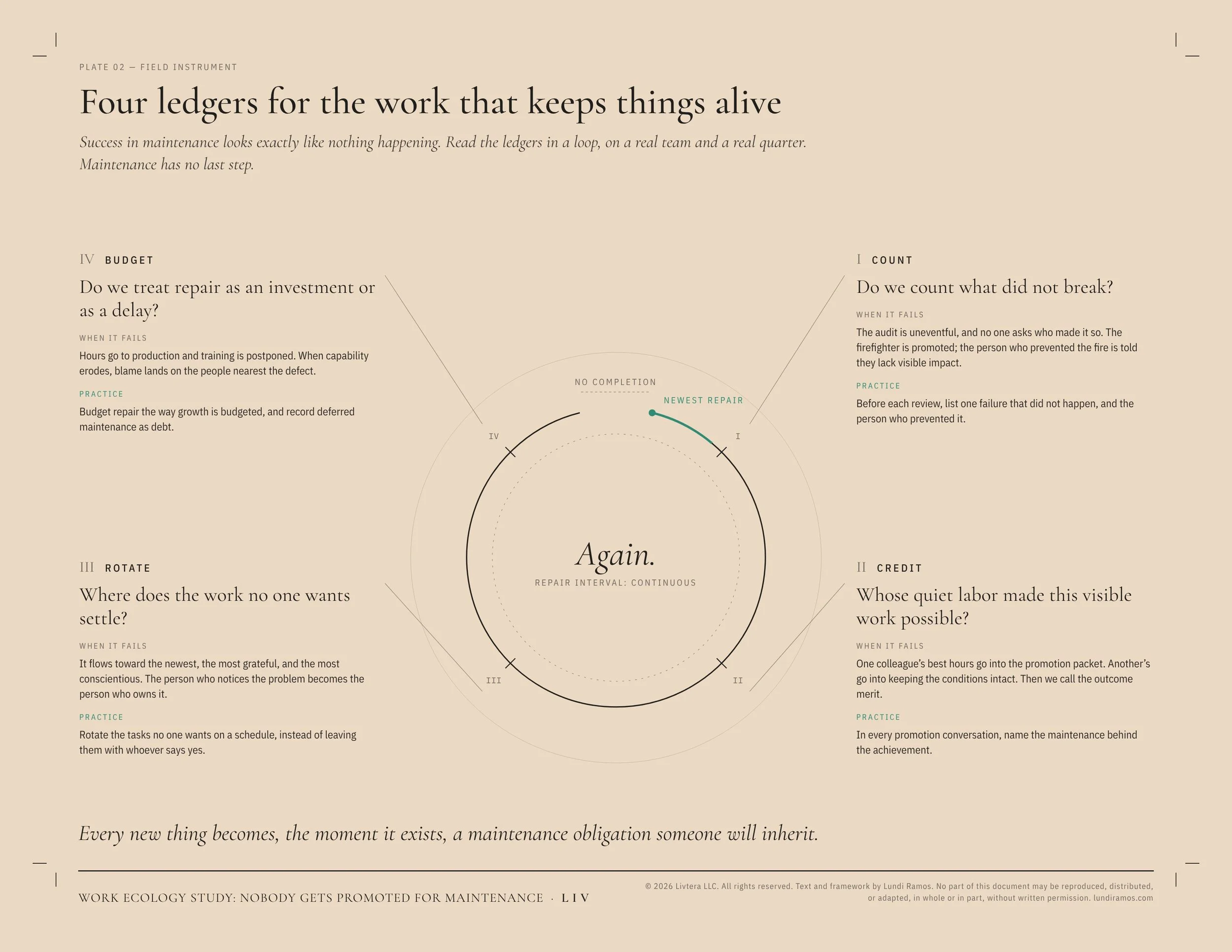
When it surfaces, managers rarely blame the deferred investment. They blame the people nearest the defect. The short-term gains from pressure become evidence that the workers were slacking before. More pressure follows. Less maintenance follows that.
Meanwhile the organization rewards the people who rescue failing projects with heroic effort. The firefighter gets promoted. The person who quietly kept the building from catching fire gets a performance review that notes their lack of visible impact.
The trap holds because the people inside it rarely know they are in it.
This is how an institution spends its own soil. Not through a single bad decision, but through a habit of perception. It sees rescue and cannot see care.
Who Gets Asked
Invisible work does not fall evenly. It flows, like water, toward the people least able to refuse it.
In 2017, the economists Linda Babcock, Maria Recalde, Lise Vesterlund, and Laurie Weingart published research on what they called low-promotability tasks: the committee no one wants to chair, the report someone has to write, the event someone has to organize. Necessary work. Work that rarely advances the person who does it.
In their experiments, women volunteered for such a task more often than men. They were also asked more often, and they were more likely to say yes when asked. The requests seemed to follow a lesson already learned about whose time was available.
The research concerns gender, but the pattern is easy to recognize elsewhere. The same current pulls toward the newest employee, the person who is grateful to be in the room, the one who cannot afford to be called difficult. It pulls toward conscientiousness itself. The person who notices the problem becomes the person who owns it.
Over a career, the cost compounds. One colleague spends their best hours on work that will appear in their promotion packet. Another spends theirs keeping the conditions intact so the first colleague's work is possible.
Then we call the outcome merit.
Monday Morning at Kind
When I started Kind in 2016, the commitments that mattered most to me were not the visionary ones. They were the boring ones.
We pay therapists on a Net-10 schedule instead of asking them to wait months for an insurance company to acknowledge their labor. That promise sounds like a policy. In practice it is a recurring act of maintenance. Sessions have to be reconciled, errors chased, and money moved, again and again, whatever went wrong with the claim. A therapist experiences it as being paid on time. Nobody experiences it as an achievement.
That is precisely the point. A humane workplace is mostly made of things that have to happen again.
Free supervision has to be scheduled again. Continuing education has to be found, vetted, and offered again. Trust has to be tended after every hard conversation, not only after the first one. Values announced once and maintained never are not values. They are marketing with a short memory.
I have learned to judge an organization less by what it launches than by what it is still doing three years later, on an ordinary Monday, when no one is watching and no one will be thanked.
Maintenance is where values stop being language and become physical.
What We Are Preserving
There is a cultural romance about building. Founders build. Leaders build. Movements build. The word carries a sense of authorship, of standing over something that did not exist before.
Ukeles saw the trap in that romance more than fifty years ago. Development is seductive because it ends. Maintenance never ends, so it never offers the satisfaction of completion, and it never produces a moment when someone can say: I made this.
But nearly everything we depend on is maintained rather than new. The water arriving through old pipes. The power grid. The archive. The children's teeth. The friendship that survives because someone keeps calling. The language you are reading now, preserved by people whose names no one recorded.
An economy that rewards only development will slowly consume what development produced. It will keep launching things it cannot keep alive.
Every new thing becomes, the moment it exists, a maintenance obligation someone will inherit.
The question is whether we know who that someone is.
What We Could Build
I do not think the answer is to make maintenance glamorous. Glamour would ruin it. Maintenance asks for a particular humility: a willingness to do work that succeeds by disappearing.
The answer is to make it visible to the systems that distribute reward.
That begins with counting what did not break. In a promotion conversation, it sounds like asking whose quiet labor made this person's visible work possible. The tasks no one wants can rotate instead of settling on whoever says yes. Repair can be budgeted the way growth is budgeted, and deferred maintenance can be recorded as what it is, which is debt. And the people who do this work can be paid as though we understood what would happen if they stopped.
New York learned what would happen. In February 1968, the year before Ukeles wrote her manifesto, sanitation workers went on strike. In little more than a week, more than 100,000 tons of garbage accumulated on the streets. The city did not need a theory of maintenance after that. It had a smell.
Most institutions never get the strike. Their maintainers rarely walk out all at once. They simply get tired, and leave, and take with them the knowledge of how things were kept alive. The organization notices only later, when the floor is no longer clean and no one remembers why it ever was.
Ukeles shook 8,500 hands to say what the institution had never said. It took an artist to help the city hear it. That is often what artists are for.
Thank you for keeping this alive.
The future of work will be decided less by what we invent than by whether we can learn to see the people who keep things from falling apart.
Research Behind This Essay
The following history and research inform the essay's examination of maintenance, invisible labor, and how institutions distribute credit. These sources use different methods and contexts; none independently establishes the broader Work Ecology framework.
Ukeles, M. L. (1969). Maintenance Art Manifesto 1969! Proposal for an Exhibition "CARE." Published in Artforum, 1971.
The manifesto that divides human effort into development and maintenance, and asks who will pick up the garbage on Monday morning.
Ukeles, M. L. (1979–1980). Touch Sanitation [Performance]. New York City Department of Sanitation.
Over almost a year, Ukeles walked sanitation routes and garages and thanked more than 8,500 New York City sanitation workers in person.
Repenning, N. P., & Sterman, J. D. (2001). Nobody ever gets credit for fixing problems that never happened: Creating and sustaining process improvement. California Management Review, 43(4), 64–88.
https://cmr.berkeley.edu/2001/08/43-4-nobody-ever-gets-credit-for-fixing-problems-that-never-happened-creating-and-sustaining-process-improvement
A study of why improvement programs fail: working harder pays off at once, investing in capability pays off later, so organizations defer maintenance and reward firefighting.
Babcock, L., Recalde, M. P., Vesterlund, L., & Weingart, L. (2017). Gender differences in accepting and receiving requests for tasks with low promotability. American Economic Review, 107(3), 714–747.
https://econpapers.repec.org/RePEc:aea:aecrev:v:107:y:2017:i:3:p:714-47
Experiments showing that women volunteer for, are asked to take on, and accept low-promotability tasks more often than men.